What it is
A personal weather station is a set of consumer sensors mounted at a home, a school or a farm. It usually has a thermometer and hygrometer in a small shield, a wind cup and vane or a sonic sensor, a tipping rain gauge and a barometer indoors. A console or a small computer sends a reading to the internet every few minutes. Tens of thousands of them stand across the country, far more than the official stations, and a network run with the Weather Service, the Citizen Weather Observer Program, passes many of their reports on to forecasters.
What it is not
It is not held to a standard. An airport station is sited, maintained and checked to a federal handbook, ASOS FB-INS-002; a home station stands wherever its owner can put it. Its sensors can be very good, and its readings can still be far off, because the site decides most of what it measures.
Lookalikes
- An airport station
- Sited, maintained and checked to a federal standard, ASOS FB-INS-002.
- A cooperative observer
- A volunteer with standard instruments supplied and inspected by the Weather Service, reading once a day, the long record behind the climate.
The machine
Siting
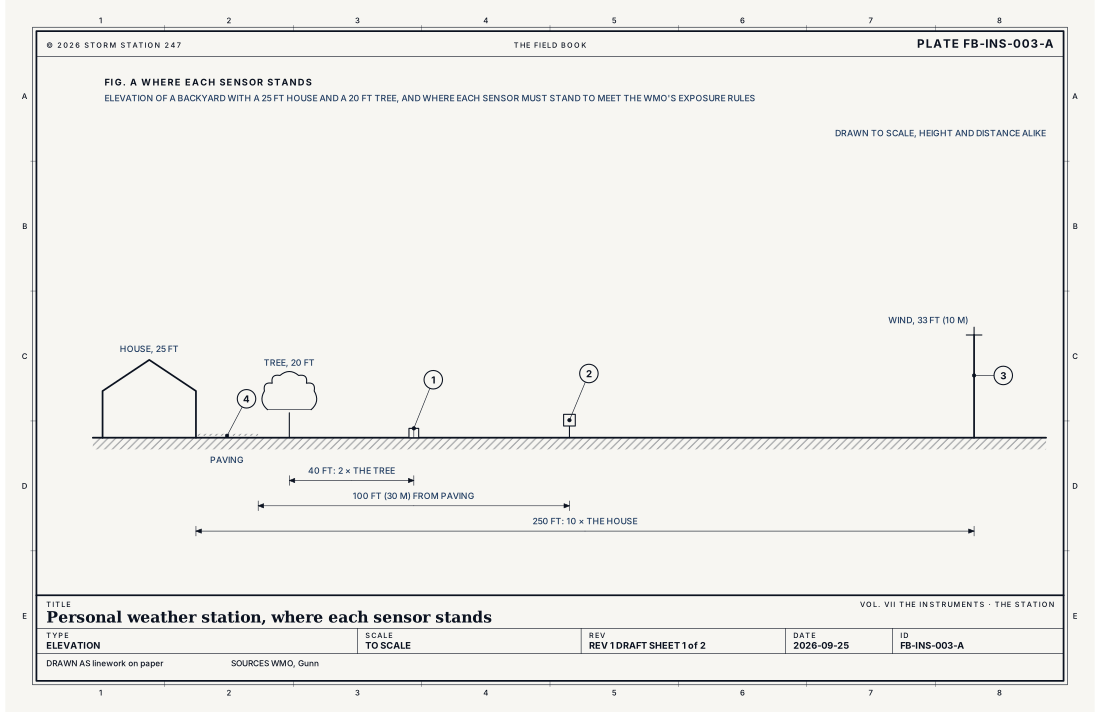
Fig. A draws a backyard to scale and the rules for each sensor, from the WMO's guide to instruments. The wind sensor belongs at 33 ft (10 m), at least ten times an obstacle's height from it. Behind a house 25 ft tall, that is 250 ft away. The rain gauge needs every object at least twice its height away: 40 ft from a tree 20 ft tall. The thermometer belongs at about 5 ft over grass, in a shield, at least 100 ft (30 m) from paving, walls and water for a good siting class, Stevenson screen and siting FB-INS-009. Few yards allow all three, and a roof, where many stations go, suits none of them.
The rain shadow
Rain does not fall straight down in wind. It falls at an angle set by the wind and the drop's own fall speed, and anything tall throws a rain shadow downwind. Fig. B draws a tree 20 ft tall. Drops 0.04 in (1 mm) across fall 13.2 ft/s (4.03 m/s) in still air, and their shadow reaches 11 ft beyond the tree in a 5 mph wind and 44 ft in a 20 mph wind. A gauge at twice the tree's height stays out of the shadow of those drops in winds up to 18 mph, and of larger 0.08 in (2 mm) drops up to 29 mph. Closer in, it catches less rain than fell.
The sun
A small shield in sunlight, with little wind to cool it, warms its thermometer above the air, and paving and walls add their own heat. That is why the home station that reads hottest in a town on a sunny afternoon is often the one worst sited, not the one in the hottest air.
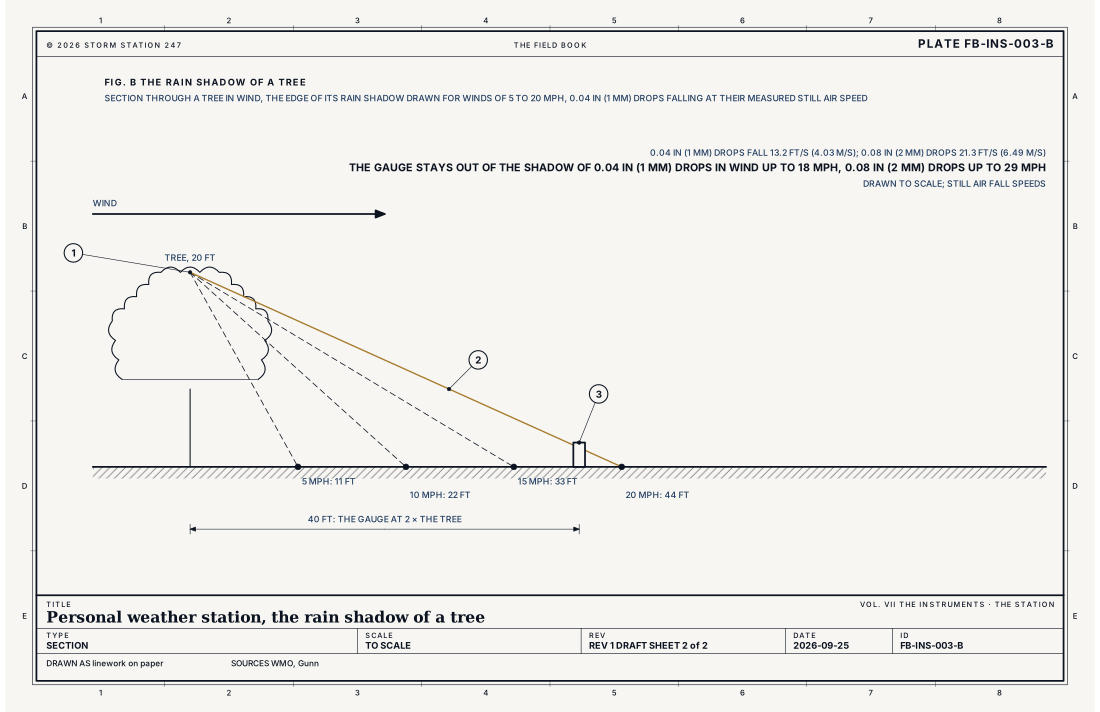
- The treetop
- The shadow's edge at 20 mph
- The gauge, twice the tree's height away
Ingredients
- Sensors: temperature and humidity in a small shield, wind, rain and pressure
- A site: the yard, the roof and what stands around them
- A connection that sends each reading to the internet, and to networks that collect them
Scales
- time
- a reading every few seconds to every few minutes
- horizontal
- a point in a yard; its value depends on the ground within a few hundred feet (100 m)
- vertical
- from the ground to the top of its mast, often a roof
- orlanski
- micro
Signatures
- surface
- afternoon highs above every neighbour on sunny days; from a shield in the sun or near paving; wind that never gusts; from a mast in the lee of a roof; rain totals below a gauge in the open; from a gauge under a tree
The numbers
| Quantity | Value, and the kind of number it is |
|---|---|
| Wind exposure | The wind sensor at 33 ft (10 m), at a distance of at least ten times the height of any obstacleStandard, Guide to Instruments and Methods of Observation (WMO-No. 8) |
| Rain gauge exposure | Any object at least twice its height above the gauge's rim away from the gaugeStandard, Guide to Instruments and Methods of Observation (WMO-No. 8) |
| Thermometer siting | At 4.1 to 6.6 ft (1.25 to 2 m) over grass; class 2 siting needs no paving, building or water within 100 ft (30 m)Standard, Guide to Instruments and Methods of Observation (WMO-No. 8) |
| Raindrop fall speed | 0.04 in (1 mm) drops fall 13.2 ft/s (4.03 m/s) and 0.08 in (2 mm) drops 21.3 ft/s (6.49 m/s) in still airTextbook, Gunn 1949 |
How the station sees it
This site does not carry personal stations. Their readings can be compared with the standard stations it does carry: the nearest airport station for the temperature and wind, the cooperative observers for the day's high, low and rain, and the community rain gauges read each morning. A home station that stays within a degree or two of those, and whose rain totals track theirs over weeks, is well sited.
- Airport weather stations: the nearest standard station, to compare a home station's readings against
- Cooperative observers: the day's high, low and rain, from standard instruments, the check on a home station's day
- Community rain gauges: volunteers' standard gauges, read each morning, the check on a home station's rain
How it is warned
Personal stations are not used to issue warnings. Forecasters watching a storm may still look at them, because a dense network of home stations can show a gust front or a flooding downpour between the official stations.
See also
- What an instrument is FB-INS-001
- ASOS FB-INS-002
- Stevenson screen and siting FB-INS-009
- Humidity variables FB-WAT-002
- Urban heat FB-LND-003
Sources
- World Meteorological Organization. Guide to Instruments and Methods of Observation (WMO-No. 8).
- Gunn, R. and G. D. Kinzer. The Terminal Velocity of Fall for Water Droplets in Stagnant Air, Journal of Meteorology 6 (1949).
Definition after the Guide to Instruments and Methods of Observation (WMO-No. 8). Plate FB-INS-003, revision 1, 2026-09-25. The number is permanent; cite it.