What it is
An ice storm is freezing rain that goes on long enough to load the land with ice. The rain falls as liquid, but it falls through air and onto ground below freezing, and it freezes on whatever it strikes: every twig, every wire, every road and car. The ice it builds is glaze, clear and hard, and it grows as long as the rain lasts.
The Weather Service warns of an ice storm when freezing rain is expected to build ice a quarter of an inch (6 mm) thick or more; a few offices wait for half an inch (13 mm). A quarter inch sounds small. On a power line it is a sleeve of ice all the way along, and on a tree it is a coat on every branch, and the weight adds up quickly. Fig. B works it out for one wire, and Fig. C shows how fast it grows.
What it is not
It is not sleet. Sleet is ice pellets: drops that froze again on the way down and bounce when they land, Sleet event FB-EVT-085. Sleet piles up like coarse sand, and it is slick, but it does not stick to wires and branches the way freezing rain does.
It is not black ice. Black ice is a thin clear sheet on a road from dew, drizzle or melt freezing, and it needs no storm at all.
It is not rime. Rime is white and feathery, built by fog or cloud droplets blowing onto cold objects. Glaze is clear, and it is built by rain.
Lookalikes
- Sleet
- Ice pellets that bounce on landing; the cold layer is deep enough to freeze the drops before they reach the ground.
- Black ice
- A thin, clear sheet on a road from dew, drizzle or meltwater freezing, with no storm needed.
- Rime
- White, feathery ice built by supercooled fog or cloud blowing onto objects, not by falling rain.
The machine
The layers of air that make it
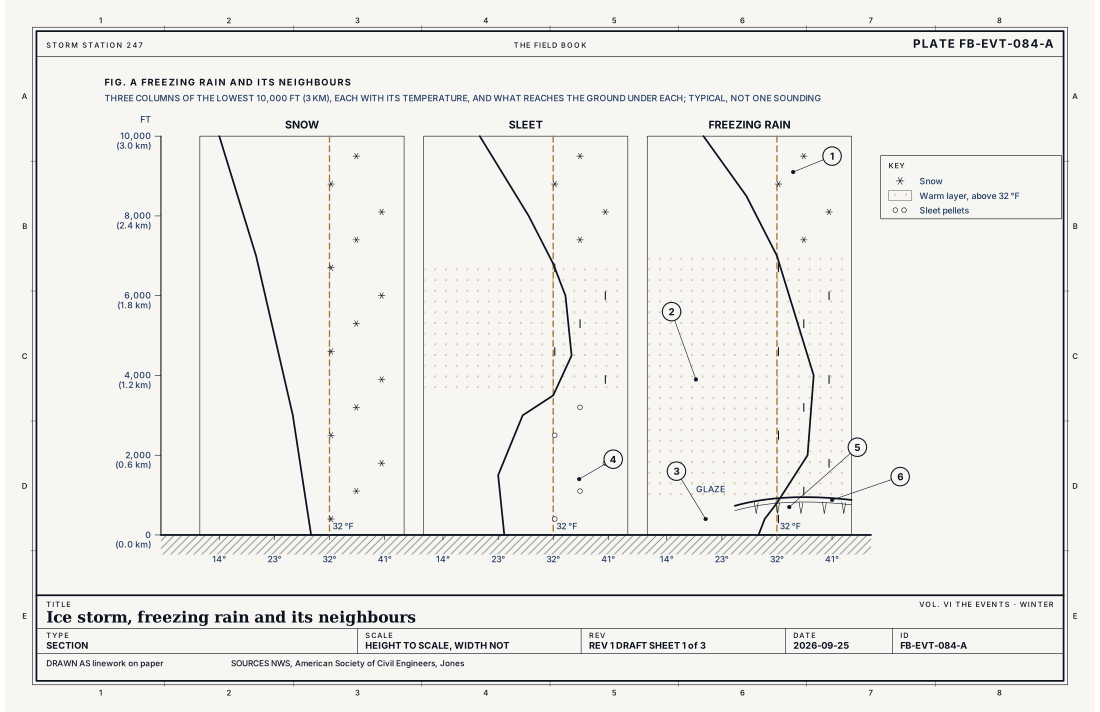
Almost all rain in winter starts as snow. Whether it reaches the ground as snow, sleet or freezing rain depends on the air it falls through, and Fig. A draws the three cases side by side.
If the air is below freezing all the way down, the snow stays snow. If a layer of warm air lies above the ground, commonly a few thousand feet thick and a few degrees above 32 °F (0 °C), the snow melts into rain as it falls through it. Below that warm layer, what happens next depends on the cold air beneath. A deep cold layer, a few thousand feet thick, freezes the drops again into sleet before they land. A shallow cold layer, only a few hundred feet deep, cannot freeze them in time. The drops arrive as liquid water colder than freezing, supercooled, and they freeze the moment they touch something solid.
This layering happens along the edge of the cold air, north of a warm front or where cold air is dammed against the east side of a mountain range, while a winter storm, Winter storm FB-EVT-080, pushes warm, moist air up over it. The band of freezing rain is often narrow, tens of miles wide, with snow on its cold side and plain rain on its warm side, and a small shift in the warm layer moves it, Wintry mix and changeover FB-EVT-091.
How the ice grows
A drop that freezes gives up its heat to the object it strikes. When the air is only just below freezing, some of the water runs off before it freezes and hangs in icicles; in colder air more of it freezes where it lands. Either way the ice grows by layers, and it keeps growing as long as the rain lasts.
The second equation below turns rain into ice for a wire in calm air: each inch (25 mm) of freezing rain builds about a third of an inch (9 mm) of ice all round the wire. So the quarter inch that brings a warning takes about 0.7 in (18 mm) of rain, a long, steady rain of the kind a winter storm can give. Wind drives more drops sideways onto the wire and builds ice faster.
Why the weight breaks things
The first equation weighs the ice on a wire. The ice is counted as an even ring round the wire, the way the design standard counts it, though the real shell is lumpier and hung with icicles. Because the ring grows outward, its weight grows faster than its thickness: half an inch of ice on a wire an inch across weighs 0.92 lb a foot (1.36 kg a metre), and one span of 300 ft (91 m) between poles carries 275 lb (125 kg) of ice. Fig. C draws the curve.
Trees suffer the same arithmetic on every branch at once. Limbs bend, then crack, and they fall onto the lines below. Wind on an iced wire or tree adds its push to the weight, High wind FB-EVT-150, which is why the worst damage often comes when the wind rises after the rain.
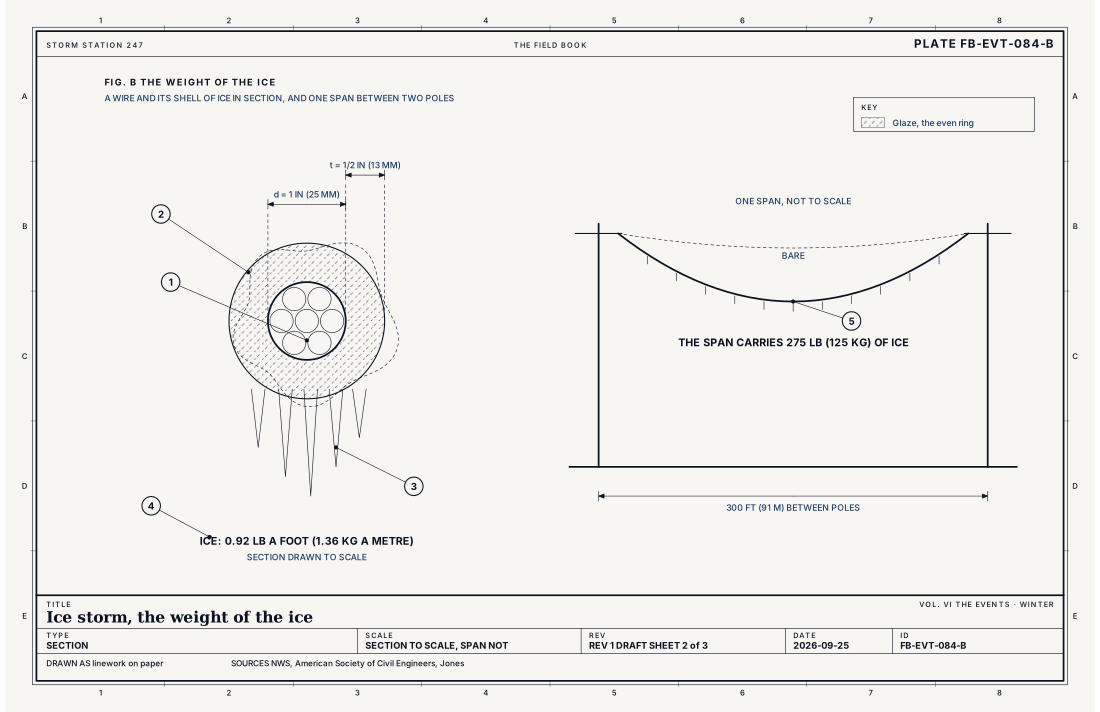
- The wire
- The ice, as an even ring
- The real shell, and its icicles
- The weight a foot
- One span, and its sag
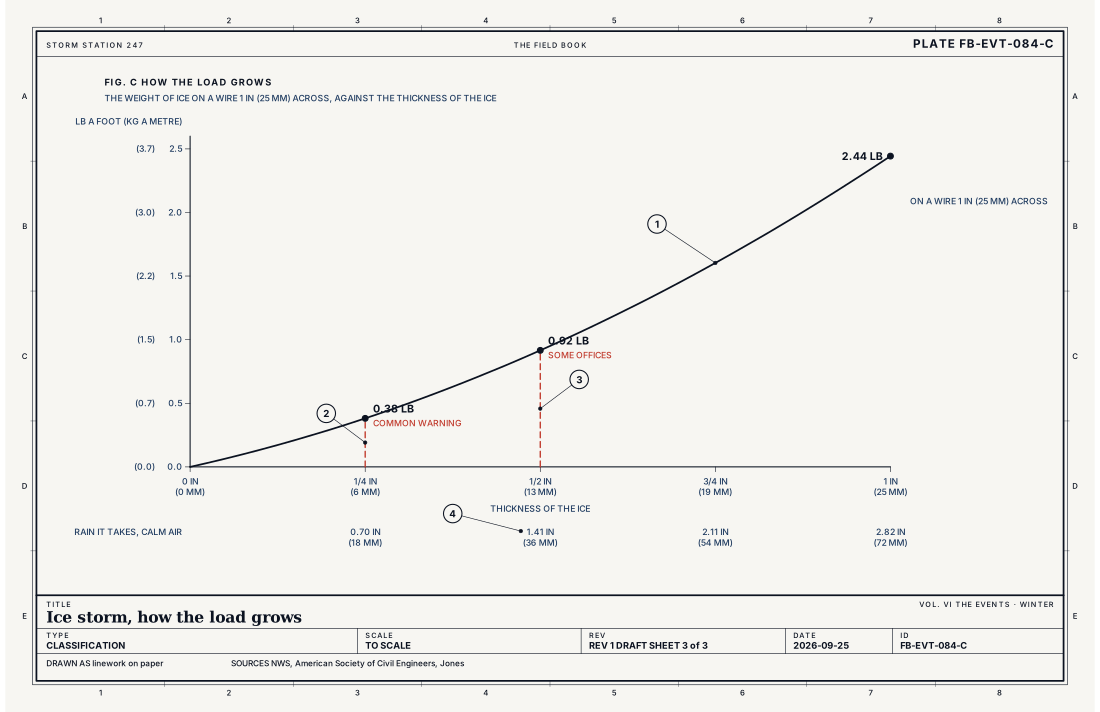
- The weight a foot
- A quarter inch (6 mm), the common warning
- Half an inch (13 mm), in some offices
- The rain it takes, in calm air
Ingredients
- Snow aloft, falling from a winter storm
- A warm layer above the ground, warm enough and deep enough to melt the snow into rain
- A shallow layer of air below freezing at the ground, too shallow to freeze the drops again before they land
- Surfaces below freezing: the ground, trees, wires and roads, on which the supercooled drops freeze
Scales
- time
- several hours to two days of freezing rain; the ice can stay for days after
- horizontal
- a band tens of miles (tens of km) wide and hundreds of miles (hundreds of km) long, along the edge of the cold air
- vertical
- a warm layer a few thousand feet (about 1 km) thick, over a cold layer at the ground a few hundred to a few thousand feet deep
- orlanski
- meso-alpha to synoptic
Equations
The weight of the ice on a wire
- the weight of ice on a length of wire, lb ft⁻¹
- the density of glaze ice, 56 lb ft⁻³ (900 kg m⁻³)
- the thickness of the ice, measured out from the wire as if it were an even ring, ft
- the diameter of the wire, ft
Assumes The ice as an even ring of equal thickness all round, the equivalent of the lumpier shell and icicles that really form, as the design standard counts it.
Working form On a wire 1 in (25 mm) across, half an inch (13 mm) of ice weighs 0.92 lb a foot (1.36 kg a metre); over a span of 300 ft (91 m) between poles, 275 lb (125 kg).
From rain to ice
- the thickness of the ice ring, in
- the depth of freezing rain that falls, in
- the density of water, 62.4 lb ft⁻³ (1,000 kg m⁻³)
- the density of glaze ice, 56 lb ft⁻³ (900 kg m⁻³)
Assumes Calm air, all of the rain that falls on a wire freezing on it, none dripping off; wind drives more drops onto the wire and builds more ice.
Working form Each inch (25 mm) of freezing rain builds about 0.35 in (9 mm) of ice round a wire in calm air, so a quarter inch of ice takes about 0.7 in (18 mm) of rain.
Signatures
- sounding
- a warm layer above 32 °F (0 °C) aloft; commonly a few thousand feet thick; a cold layer below it at the ground; shallow enough that the drops do not freeze again
- surface
- temperature at or just below 32 °F (0 °C); often 28 to 32 °F (−2 to 0 °C); a light north or northeast wind feeding cold air; rain reported with the temperature below freezing
- satellite
- the cloud of a winter storm; its warm conveyor belt riding up over the cold air at the ground
- radar
- a band of rain on the cold side of a warm front; a bright band; where snow melting in the warm layer shows brighter than the snow above or the rain below
The numbers
| Quantity | Value, and the kind of number it is |
|---|---|
| Ice Storm Warning | Freezing rain building ice of a quarter inch (6 mm) or more, commonly; some offices use half an inch (13 mm)Typical, Directive 10-513 |
| Winter Weather Advisory | Freezing rain building less ice than the warning, or freezing drizzle, making roads and walks slickTypical, Directive 10-513 |
| Density of glaze ice | 56 lb ft⁻³ (900 kg m⁻³), used in designStandard, ASCE 7 |
| Freezing rain | Rain that falls as liquid and freezes on impact, forming a coating of glaze on the ground and on exposed objectsStandard, Glossary of Meteorology |
| Sleet | Ice pellets: drops that freeze again in a deep cold layer before they land, and bounceStandard, Glossary of Meteorology |
How the station sees it
Airport stations carry an icing sensor: a small probe that vibrates, whose note falls as ice builds on it. With the temperature and the precipitation sensor it lets the station report freezing rain, and the ice building, every minute. Road weather stations measure the temperature of the road surface itself, which decides whether rain on the road freezes. Cooperative observers measure the ice by hand, the thickness on a branch or a wire, and the rain that made it.
What no single station shows is the edge of the band. A station reading 31 °F (−0.6 °C) and one reading 34 °F (1.1 °C) a few miles apart can be on either side of it.
- Airport weather stations: the temperature, and freezing rain from an icing sensor on the mast
- Road weather stations: the road surface temperature, which decides whether the rain freezes on the road
- Cooperative observers: the ice thickness, measured by hand, and the rain that made it
How it is warned
A Winter Storm Watch is issued when a storm that may bring significant ice is a day or more away. An Ice Storm Warning is issued when freezing rain is expected to build ice commonly a quarter inch (6 mm) or more. A Winter Weather Advisory covers lighter freezing rain and freezing drizzle, enough to make roads and walks treacherous.
In an ice storm, stay off the roads. Keep away from fallen lines, and from trees and lines still standing, which can fall without warning. Keep a supply of heat, water, food and light for several days without power, and never run a generator or grill indoors.
| VTEC | Phenomenon | The alerts that carry it |
|---|---|---|
IS | ice storm | Ice Storm Warning |
WW | winter weather | Winter Weather Advisory |
See also
- Winter storm FB-EVT-080
- Blizzard FB-EVT-081
- Sleet event FB-EVT-085
- Wintry mix and changeover FB-EVT-091
- High wind FB-EVT-150
- How to read a warning FB-STN-001
Sources
- National Weather Service. Directive 10-513, WFO Winter Weather Products Specification.
- American Society of Civil Engineers. ASCE 7, Minimum Design Loads for Buildings and Other Structures, chapter 10, Ice Loads due to Freezing Rain.
- Jones, K. F.. A Simple Model for Freezing Rain Ice Loads, Atmospheric Research 46 (1998).
- American Meteorological Society. Glossary of Meteorology.
- National Weather Service. Watch, Warning, Advisory definitions.
Definition after the Directive 10-513, WFO Winter Weather Products Specification. Plate FB-EVT-084, revision 1, 2026-09-25. The number is permanent; cite it.