What it is
A thermometer left in the open does not measure the air. In sunshine it absorbs light and reads warm; at night it gives off heat to the clear sky and reads cold; near a wall or a road it reads the wall and the road. The screen is the answer: a white, louvred box that shades the thermometer, lets the air flow through it, and holds it at a fixed height over grass. Thomas Stevenson designed the double louvred version in the 1860s, and it still carries his name.
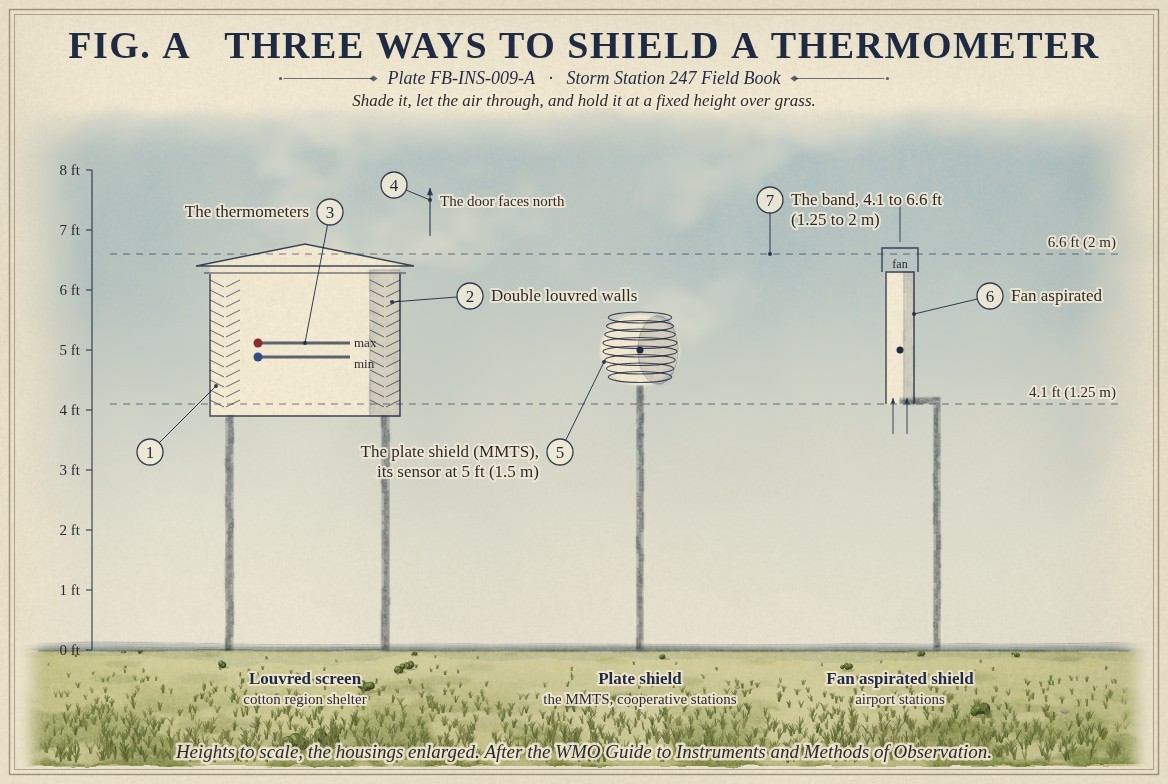
The United States has used three kinds. The louvred wooden screen, known in the United States as the cotton region shelter, held the cooperative observers' thermometers for a century. Since the 1980s most cooperative stations use the MMTS, a round stack of white plates around an electronic sensor. The airport stations use a fan aspirated shield, a tube that draws air steadily past the sensor. Fig. A draws all three.
What it is not
It is not the whole of a good temperature. A perfect screen in a parking lot still reads the parking lot. Where the screen stands matters as much as the screen, and the siting classes below are how that is judged.
It is not a thermometer on a porch or a car. Those read their own surroundings, and they are not comparable with a screened reading or with each other.
Lookalikes
- A thermometer on a porch or a car
- It measures its own surroundings: the wall, the sun on it, the engine. It is not a screened temperature, and it is not comparable with one.
- The grass minimum
- A thermometer laid just above the grass on a clear night, read for frost. It reads colder than the screen on purpose.
- A road surface temperature
- Road weather stations measure the pavement itself for ice. It is a different quantity from the air above it, What an instrument is FB-INS-001.
The machine
Shade and air
A screen does two jobs that pull against each other. It must block sunlight and the ground's heat, which argues for solid walls, and let the outside air flow freely over the sensor, which argues for no walls at all. The louvred screen does both with slatted walls set at an angle, doubled so that no straight line of light reaches inside, and a double roof with an air gap under the top. It is painted white and the door faces north, so that opening it in the Northern Hemisphere lets no sunlight in.
The weakness of a screen that relies on the wind is a still, sunny day. With little wind, the air inside warms more than the air outside, and the reading runs high. A fan fixes that: the aspirated shield keeps the same flow over the sensor in any wind, which is why the airport stations use one.
The height
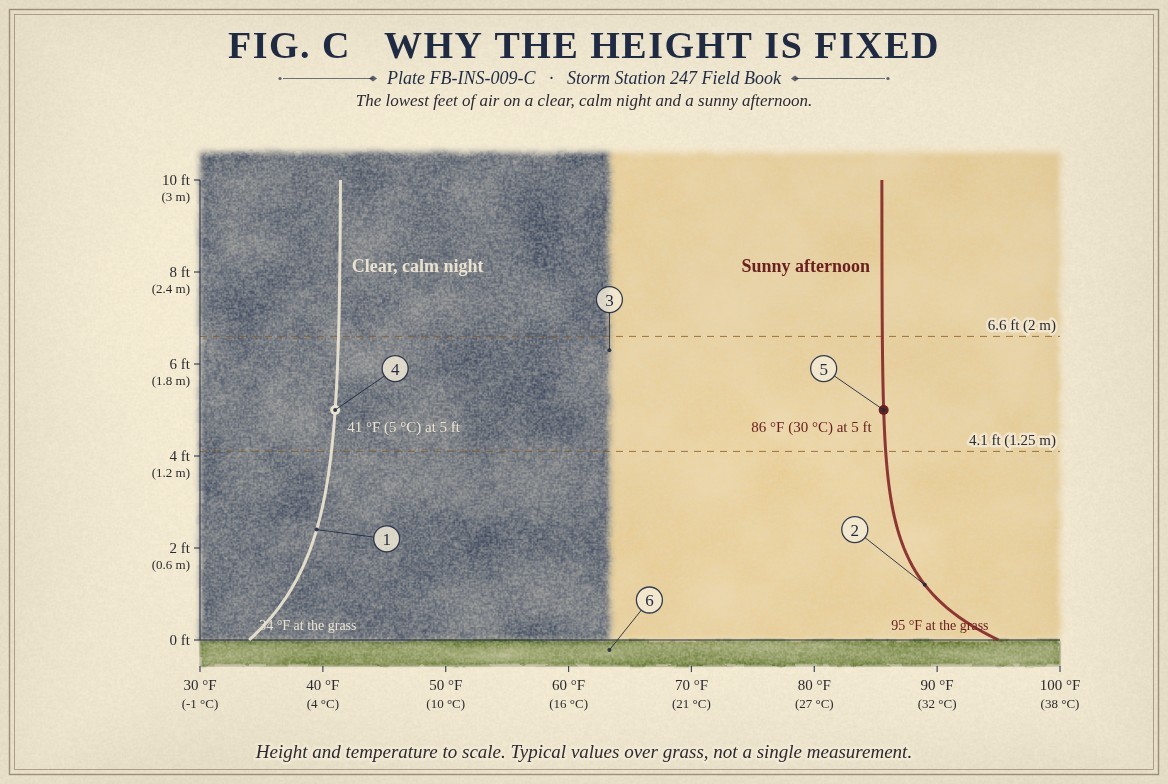
Air changes quickly with height close to the ground, and most quickly in the first few feet. On a clear, calm night the grass cools by giving off heat to the sky, and the air at the grass can be 4 to 9 °F (2 to 5 °C) colder than the air at head height. On a sunny afternoon the order reverses, and the air just above the grass is the hottest. Fig. C draws both. Between 4.1 and 6.6 ft (1.25 and 2 m), where the World Meteorological Organization places the sensor, the two curves are steadiest, so a small difference in the height of two stations makes little difference to what they read. The cooperative program fixes it at 5 ft (1.5 m), give or take a foot.
The siting classes
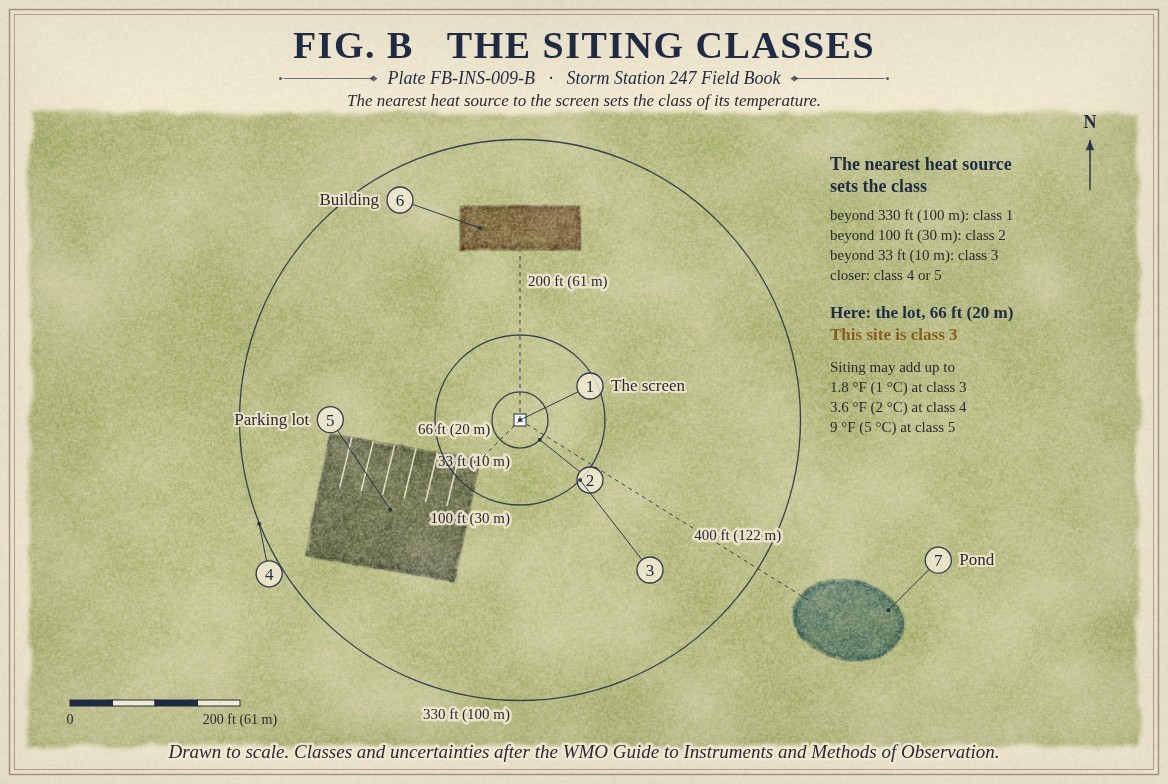
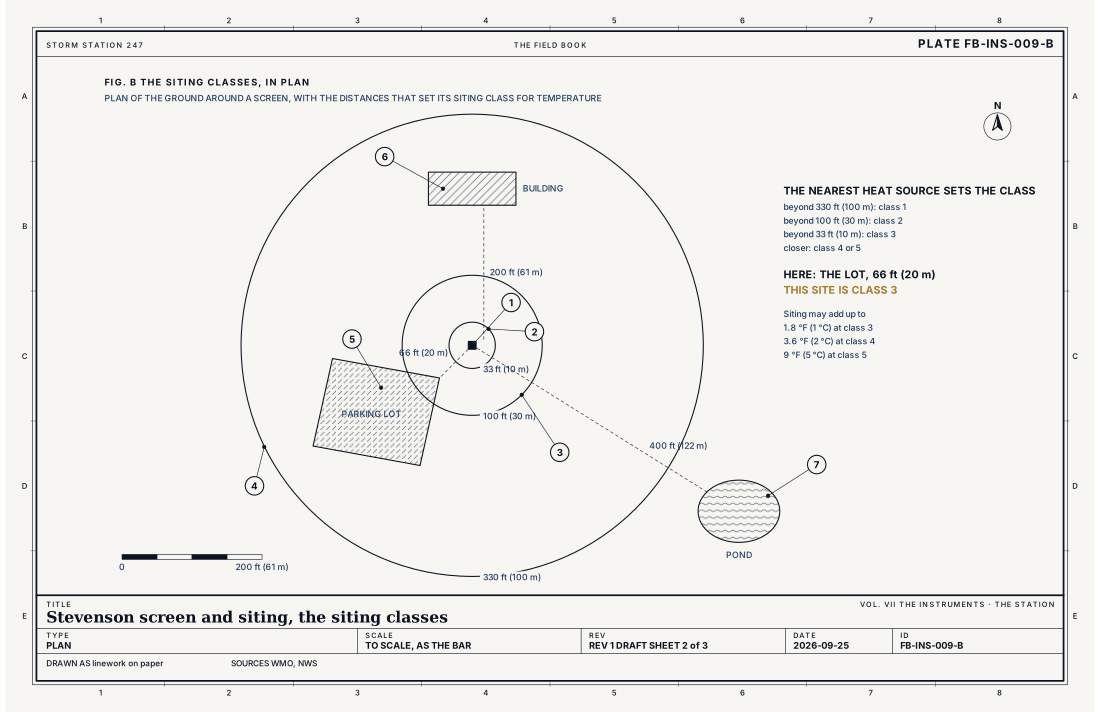
The ground around the screen is judged by distance. For temperature, a class 1 site has no pavement, building, water or other heat source within 330 ft (100 m). Class 2 allows them beyond 100 ft (30 m), class 3 beyond 33 ft (10 m). Class 4 has them closer, and class 5 is worse still. The World Meteorological Organization gives the uncertainty the siting may add: up to 1.8 °F (1 °C) at class 3, 3.6 °F (2 °C) at class 4, and 9 °F (5 °C) at class 5. Fig. B draws the rings to scale. The class describes the surroundings, not the instrument, and a good sensor in a class 5 site is still a class 5 reading.
The drawings
Each figure drawn as an engineering sheet, its parts numbered, to print at 11 by 17.
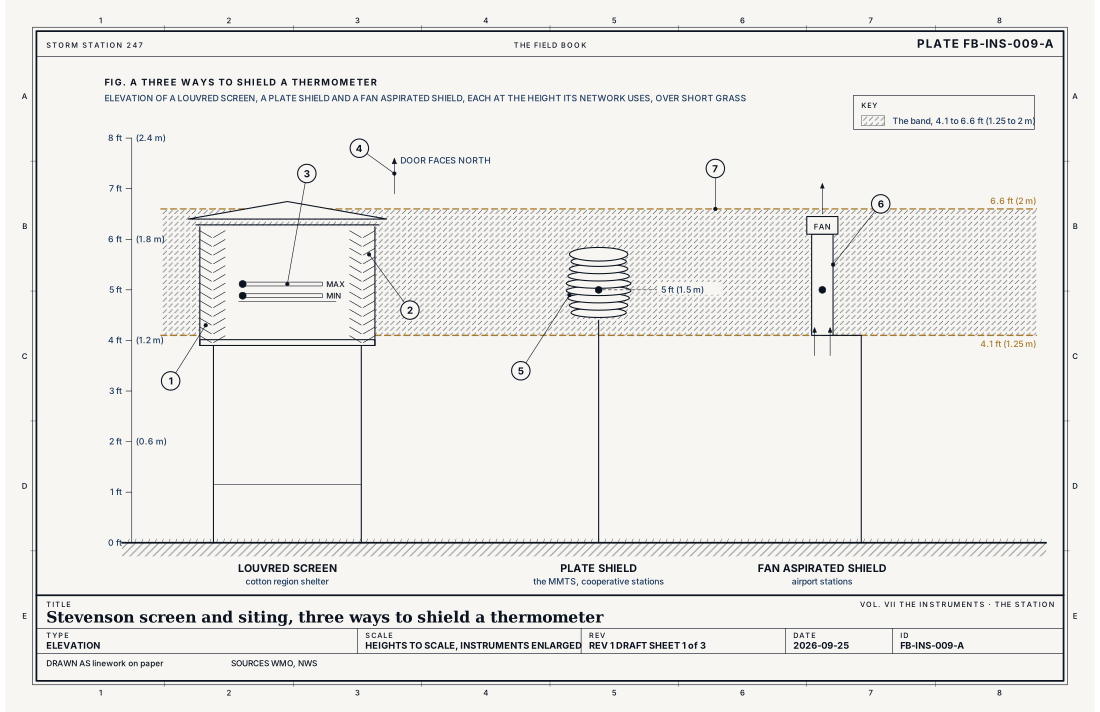
- The louvred screen, cut away
- Double louvred walls
- The thermometers inside
- The door, facing north
- The plate shield (MMTS)
- The fan aspirated shield
- The band from 4.1 to 6.6 ft (1.25 to 2 m)
- The screen
- 33 ft (10 m), the class 3 ring
- 100 ft (30 m), the class 2 ring
- 330 ft (100 m), the class 1 ring
- A parking lot 66 ft (20 m) away
- A building 200 ft (61 m) away
- A pond 400 ft (122 m) away
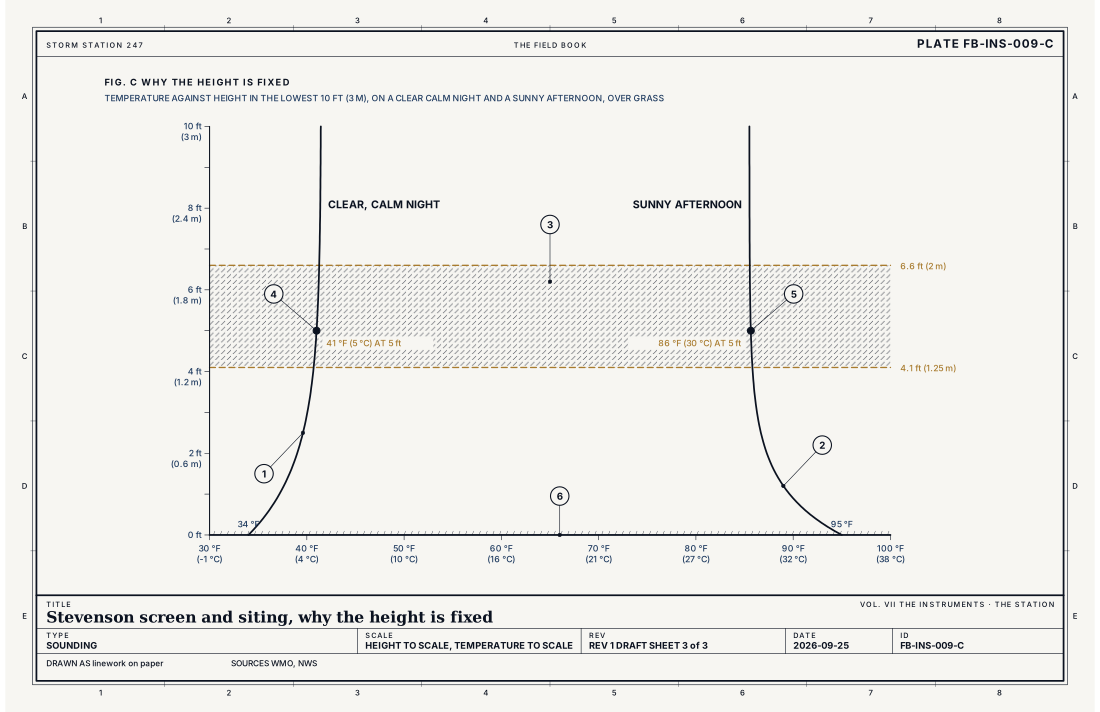
- The night curve
- The afternoon curve
- The band from 4.1 to 6.6 ft (1.25 to 2 m)
- The screen's reading at night, 41 °F (5 °C)
- The screen's reading in the afternoon, 86 °F (30 °C)
- The grass
Ingredients
- Shade: a white housing that keeps sunlight and the ground's heat off the sensor
- Ventilation: louvres, or a fan, that keep the air inside the same as the air outside
- A fixed height over a natural surface, so every station samples the same layer of air
- Distance from anything that makes or holds heat: pavement, buildings, water and machinery
Scales
- time
- a minute for an electronic sensor to follow the air; the day's highest and lowest, for a cooperative observer's thermometers
- horizontal
- the ground within 330 ft (100 m) of the screen, which its siting class describes
- vertical
- 4.1 to 6.6 ft (1.25 to 2 m), the band a screen holds the sensor in
- orlanski
- micro
Signatures
- surface
- a daily high that rises with the paving around a station; not with the weather; a night low that is warmer than the stations around it; a jump in the record when a shield was changed or a station moved
The numbers
| Quantity | Value, and the kind of number it is |
|---|---|
| Sensor height | 4.1 to 6.6 ft (1.25 to 2 m) above the ground, over short grass or the natural surfaceStandard, Guide to Instruments and Methods of Observation (WMO-No. 8) |
| Cooperative station height | 5 ft (1.5 m) above the ground, give or take 1 ft (0.3 m)Standard, Directive 10-1315 |
| Airport station height | About 5 ft (1.5 m), in a fan aspirated shieldTypical, Automated Surface Observing System (ASOS) User's Guide |
| Screen door | Facing away from the sun at the time of reading: north in the Northern HemisphereStandard, Guide to Instruments and Methods of Observation (WMO-No. 8) |
| Class 1 siting | No artificial heat source, reflecting surface or water within 330 ft (100 m); flat, open ground under low natural vegetationStandard, Guide to Instruments and Methods of Observation (WMO-No. 8) |
| Class 2 siting | None within 100 ft (30 m)Standard, Guide to Instruments and Methods of Observation (WMO-No. 8) |
| Class 3 siting | None within 33 ft (10 m); siting may add up to 1.8 °F (1 °C) to the reading's uncertaintyStandard, Guide to Instruments and Methods of Observation (WMO-No. 8) |
| Class 4 siting | Heat sources within 33 ft (10 m), covering less than half the ground there; up to 3.6 °F (2 °C) addedStandard, Guide to Instruments and Methods of Observation (WMO-No. 8) |
| Class 5 siting | Worse than class 4; up to 9 °F (5 °C) addedStandard, Guide to Instruments and Methods of Observation (WMO-No. 8) |
| Grass and screen at night | On a clear, calm night the grass can be 4 to 9 °F (2 to 5 °C) colder than the air at screen heightTypical, Wallace 2006 |
How the station sees it
Every temperature on this site came from a sensor in some kind of shield, and the record shows when the shield or the surroundings changed. A station whose daily highs creep up while its neighbours' do not has often gained a parking lot, not a warmer climate. A jump on the day an MMTS replaced a louvred screen is the change of shield, not the weather. The instrument pages keep each station's history so that such a step can be seen for what it is.
- Cooperative observers: the day's highest and lowest, most in an MMTS shield at 5 ft (1.5 m), many with records a century long
- Airport weather stations: the air temperature and dew point every minute, in a fan aspirated shield
- Road weather stations: sited for the road, beside pavement, where the siting class is low by design
How it is warned
The screen is not warned; its readings are what heat and cold warnings are judged against. A heat advisory or a freeze warning names temperatures measured the way this plate draws: in a shield, at screen height, over open ground.
See also
- What an instrument is FB-INS-001
- ASOS FB-INS-002
- Personal weather station FB-INS-003
- Humidity variables FB-WAT-002
- Atmosphere in section FB-ENG-001
- Urban heat FB-LND-003
Sources
- World Meteorological Organization. Guide to Instruments and Methods of Observation (WMO-No. 8).
- National Weather Service. Directive 10-1315, Cooperative Station Observations.
- National Weather Service. Automated Surface Observing System (ASOS) User's Guide.
- Office of the Federal Coordinator for Meteorology. Federal Meteorological Handbook No. 1, Surface Weather Observations and Reports.
- Wallace, J. M. and P. V. Hobbs. Atmospheric Science, An Introductory Survey, 2nd ed. (2006).
Definition after the Guide to Instruments and Methods of Observation (WMO-No. 8). Plate FB-INS-009, revision 1, 2026-09-25. The number is permanent; cite it.