What it is
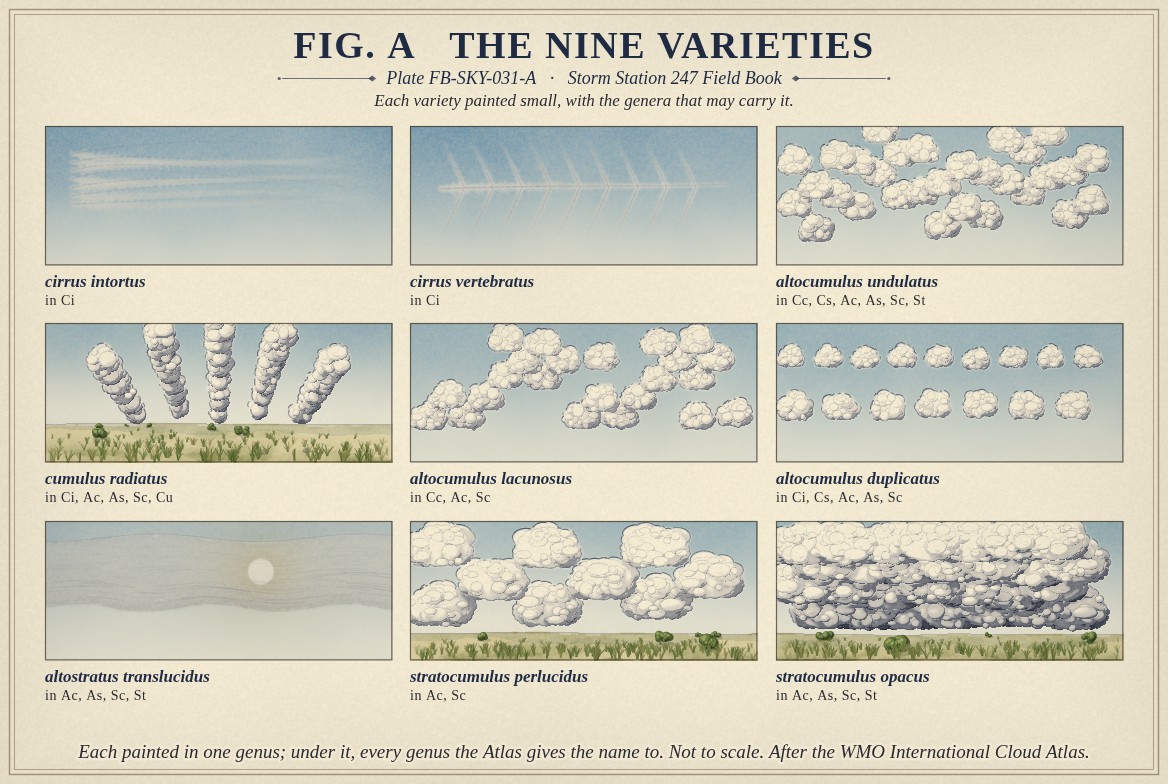
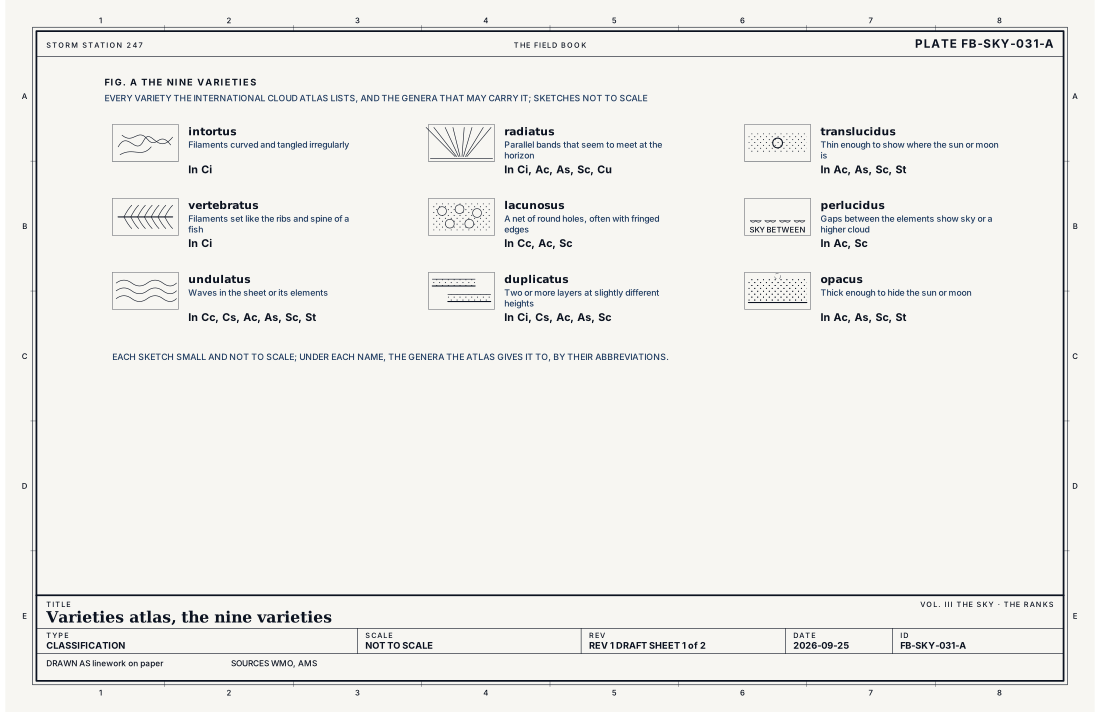
A cloud's variety is the third word of its name, after the genus and species. It says how the parts of the cloud are arranged, in waves, in bands, in a net of holes or in two layers, and how much light passes through it. The International Cloud Atlas lists nine, drawn in Fig. A with the genera that may carry each.
A cloud may carry more than one variety, with one exception: translucidus, thin enough to show where the sun is, and opacus, thick enough to hide it, cannot both apply. Intortus and vertebratus belong to cirrus alone. Undulatus is the most widely shared, found in six genera. Nimbostratus and cumulonimbus have no varieties.
What it is not
It is not the species, which says what shape the cloud is and allows only one, Species atlas FB-SKY-030. Nor is it a supplementary feature, a part attached to the cloud such as virga or mamma, Supplementary features atlas FB-SKY-032. Straight bands along flight paths are contrails, Special clouds FB-SKY-034, not radiatus.
Lookalikes
- Species
- The shape of the cloud; one to a cloud. A variety adds arrangement and transparency
- Supplementary features
- Parts attached to the cloud, such as virga or mamma; see FB-SKY-032
- Contrails
- Straight bands along flight paths; radiatus bands are cloud drawn out by the wind
The machine
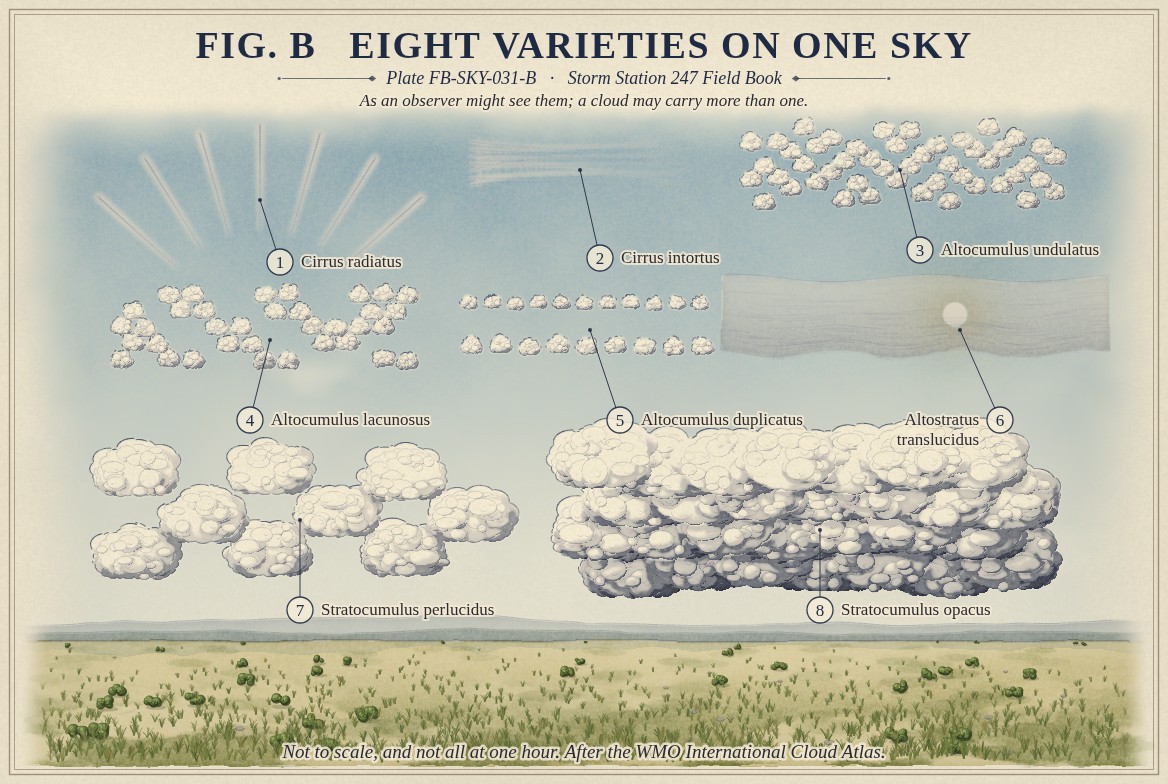
The varieties are mostly the work of the wind across a layer. Where the wind changes speed or direction with height, it draws a layer into regular waves, undulatus, or long parallel bands, radiatus, which seem to meet at the horizon only because they run away from the observer. Where air sinks or mixes through a thin sheet, it opens round holes, lacunosus. Two layers a short height apart, each formed at its own level, make duplicatus. Translucidus, perlucidus and opacus describe the light: whether the sun shows through, whether sky shows between the parts, and whether the layer hides the sun.
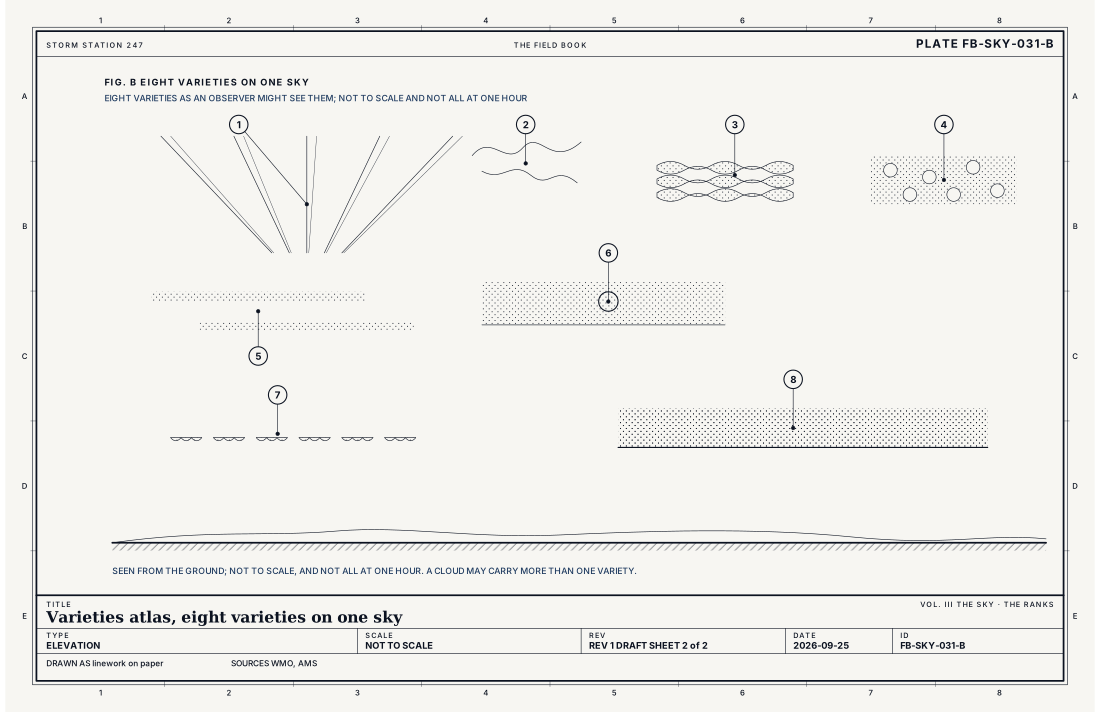
Fig. B puts eight of the nine on one sky.
The drawings
Each figure drawn as an engineering sheet, its parts numbered, to print at 11 by 17.
- intortus
- vertebratus
- undulatus
- radiatus
- lacunosus
- duplicatus
- translucidus
- perlucidus
- opacus
- Cirrus radiatus
- Cirrus intortus
- Altocumulus undulatus
- Altocumulus lacunosus
- Altocumulus duplicatus
- Altostratus translucidus
- Stratocumulus perlucidus
- Stratocumulus opacus
Ingredients
- Wind that changes with height across a layer, which draws it into waves and bands
- Air sinking or mixing through a thin layer, which opens holes in it
- The depth of the layer, which decides whether the sun shows through
Scales
- time
- minutes to hours; waves and holes come and go as the layer moves
- horizontal
- from the spacing of waves, hundreds of feet to a mile or two, to bands crossing the whole sky
- vertical
- the depth of one layer, or two layers a short height apart for duplicatus
- orlanski
- micro to meso
Signatures
- surface
- named by an observer from sight; the station reports the layer's cover and height
- satellite
- undulatus and radiatus show as regular bands; lacunosus as a net of holes
- radar
- no echo from the varieties themselves
The numbers
| Quantity | Value, and the kind of number it is |
|---|---|
| Varieties | 9: intortus, vertebratus, undulatus, radiatus, lacunosus, duplicatus, translucidus, perlucidus, opacusStandard, International Cloud Atlas |
| How many to a cloud | Any that apply, except translucidus and opacus togetherStandard, International Cloud Atlas |
| Shared most widely | undulatus, in six generaStandard, International Cloud Atlas |
| Belonging to one genus | intortus and vertebratus (cirrus)Standard, International Cloud Atlas |
| Genera with no varieties | nimbostratus and cumulonimbusStandard, International Cloud Atlas |
| Where the name goes | After the species, if there is one: altocumulus stratiformis undulatusStandard, International Cloud Atlas |
| Airport ceilometer | Cloud bases to 12,000 ft (3.7 km) overheadStandard, Automated Surface Observing System (ASOS) User's Guide |
How the station sees it
An airport station reports each layer's cover in eighths of the sky and its height, up to 12,000 ft (3.7 km), from its ceilometer. It does not name varieties, though a layer reported as broken or overcast is usually opacus.
- Airport weather stations: the cover and height of each layer overhead, to 12,000 ft
How it is warned
Varieties are not warned. Undulatus in a thin layer is a sign of wind shear at that height, which pilots feel as turbulence.
See also
- Cloud classification FB-SKY-001
- Species atlas FB-SKY-030
- Supplementary features atlas FB-SKY-032
- Accessory clouds FB-SKY-033
- Altocumulus FB-SKY-013
- Altostratus FB-SKY-014
- Stratocumulus FB-SKY-016
Sources
- World Meteorological Organization. International Cloud Atlas.
- American Meteorological Society. Glossary of Meteorology.
Definition after the International Cloud Atlas. Plate FB-SKY-031, revision 1, 2026-09-25. The number is permanent; cite it.