What it is
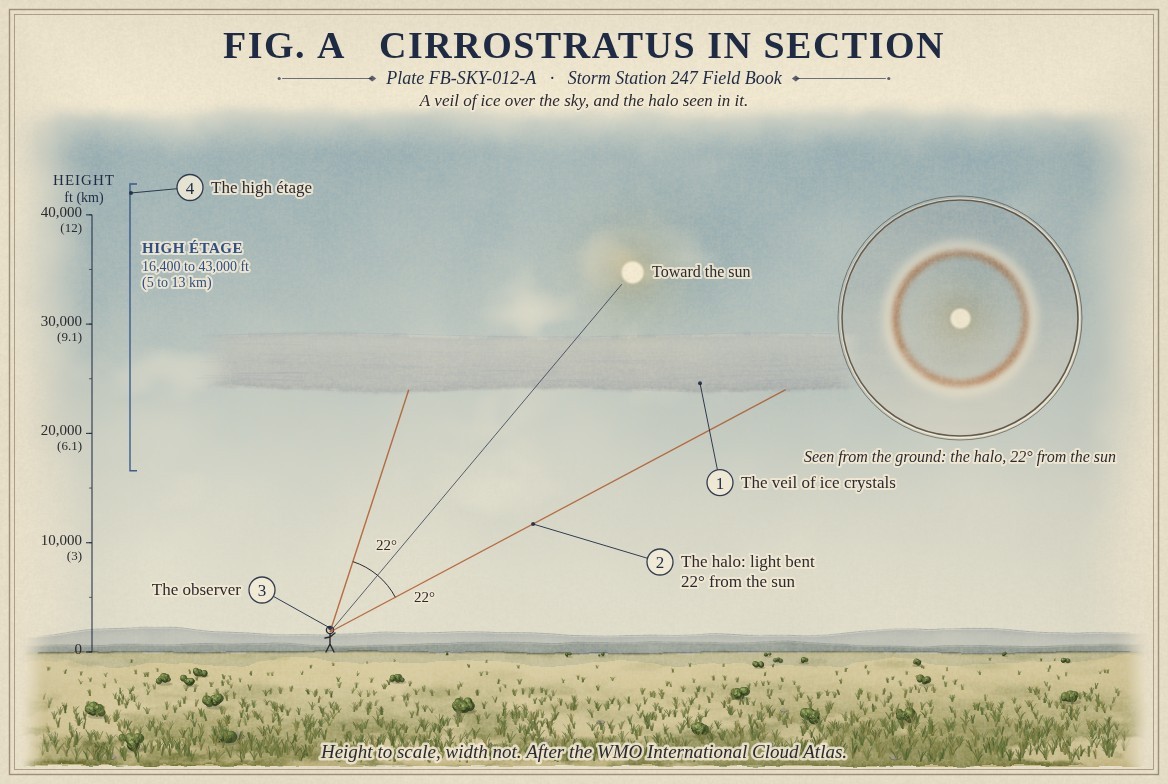
Cirrostratus is a thin whitish veil of ice over much or all of the sky, smooth or finely fibrous. It stands in the high étage, from 16,400 to 43,000 ft (5 to 13 km) in the middle latitudes, Cloud classification FB-SKY-001. It is thin enough that the sun still casts shadows through it, and sometimes so thin that the only sign of it is a milky look to the blue and a halo round the sun or moon.
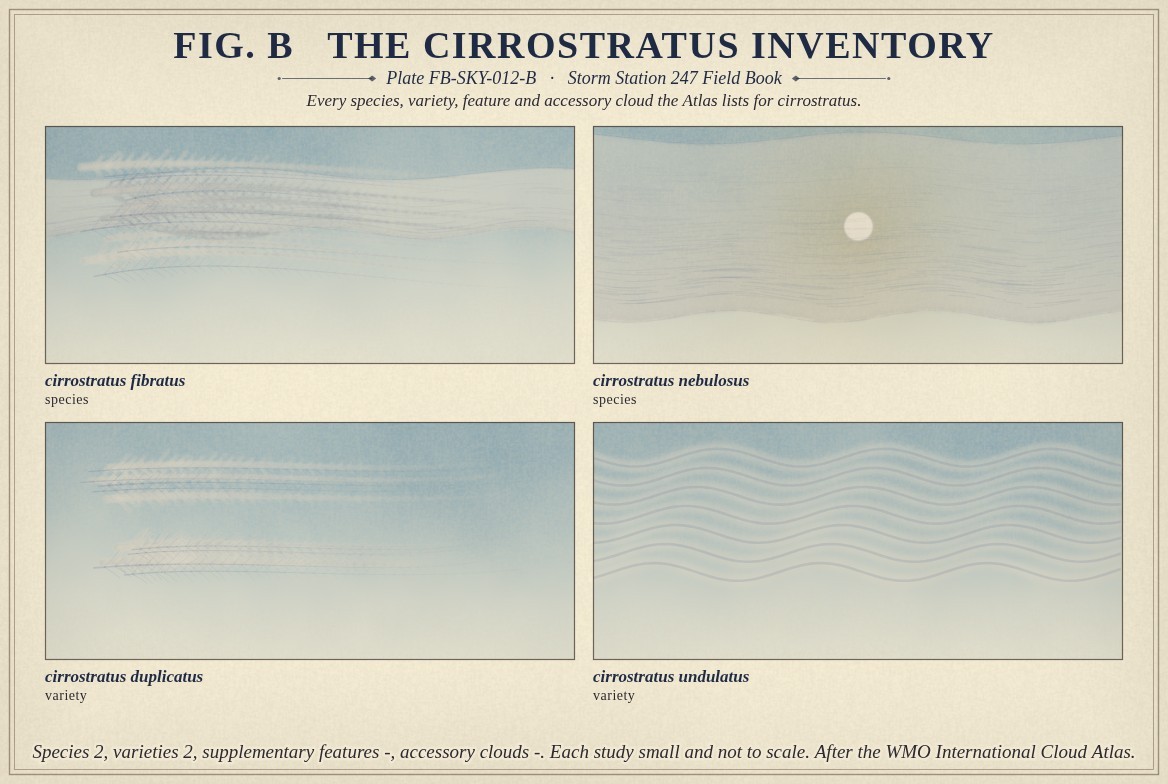
The Atlas lists two species: fibratus, a veil with fine fibres in it, and nebulosus, a veil with no detail at all. Two varieties, duplicatus and undulatus, describe a veil in two layers and one with waves. The Atlas gives cirrostratus no supplementary features and no accessory clouds. Fig. B draws each name.
What it is not
It is not altostratus, Altostratus FB-SKY-014, which is thicker, grey and lower, and through which the sun shows as through ground glass with no halo. The halo is the quickest test: a halo means ice crystals thin enough to see through, and that is cirrostratus.
It is not cirrus, Cirrus FB-SKY-010, which stands in separate filaments and patches with clear sky between. It is not haze, which is dry particles low in the air and makes no halo.
Lookalikes
- Altostratus
- Thicker and grey. The sun shows as through ground glass, and there is no halo.
- Cirrus
- Separate filaments and patches with blue sky between.
- Haze
- Dry particles in the air, low, with no halo.
The machine
Cirrostratus forms where a broad layer of moist air high in the troposphere is lifted slowly and evenly, as happens over the sloping surface of a warm front hundreds of miles ahead of where the front meets the ground. The lift is gentle and wide, so the cloud is a sheet rather than heaps, and the air is far below freezing, so the sheet is ice.
The halo in Fig. A comes from the crystals' shape. Many of the ice crystals in cirrostratus are six sided columns and plates. Light entering one side and leaving by another is bent, and for that pair of faces the least it can be bent is about 22 degrees. Light piles up at that least angle, so a ring of light appears 22 degrees from the sun or moon, reddish on its inside edge. An outstretched hand, thumb to little finger, spans about that much of the sky. Other shapes and angles of crystal make the rarer arcs and spots of the halo family, Halo family FB-SKY-051.
A veil of cirrostratus that thickens and lowers over some hours, until the halo fades and the sun turns watery, is altostratus arriving. That is the sequence ahead of a warm front, and rain or snow often follows within a day, Nimbostratus FB-SKY-015. A veil that stays thin can pass with no weather at all.
The drawings
Each figure drawn as an engineering sheet, its parts numbered, to print at 11 by 17.
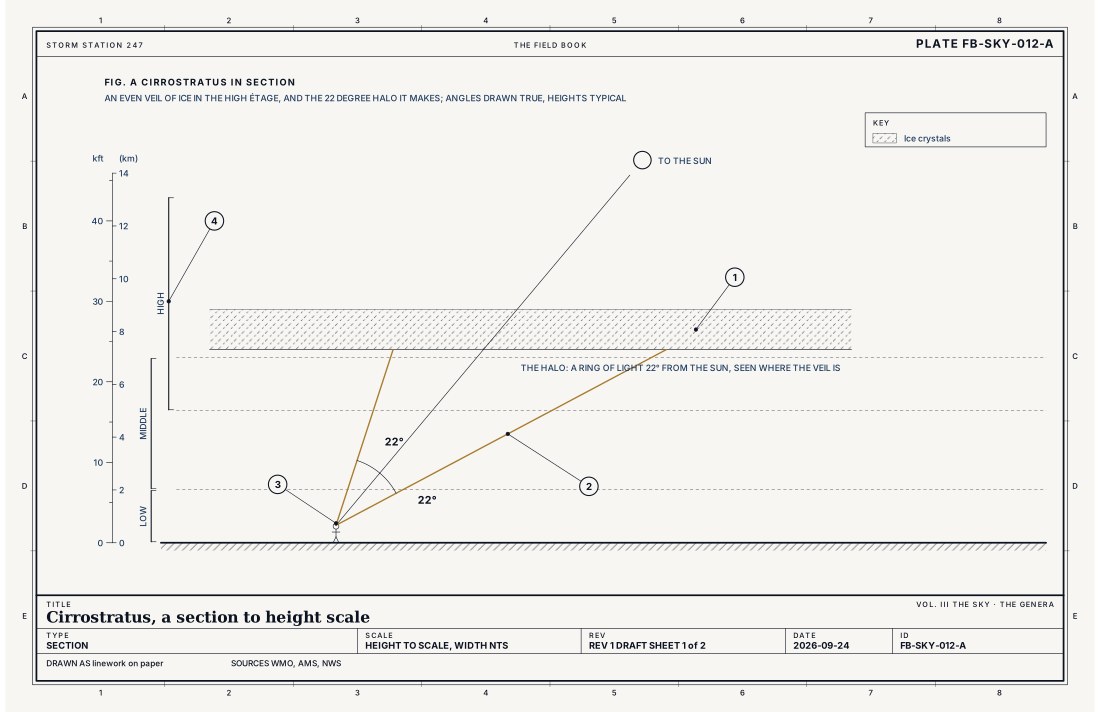
- The veil of ice crystals
- The halo: light bent 22° from the sun
- The observer
- The high étage
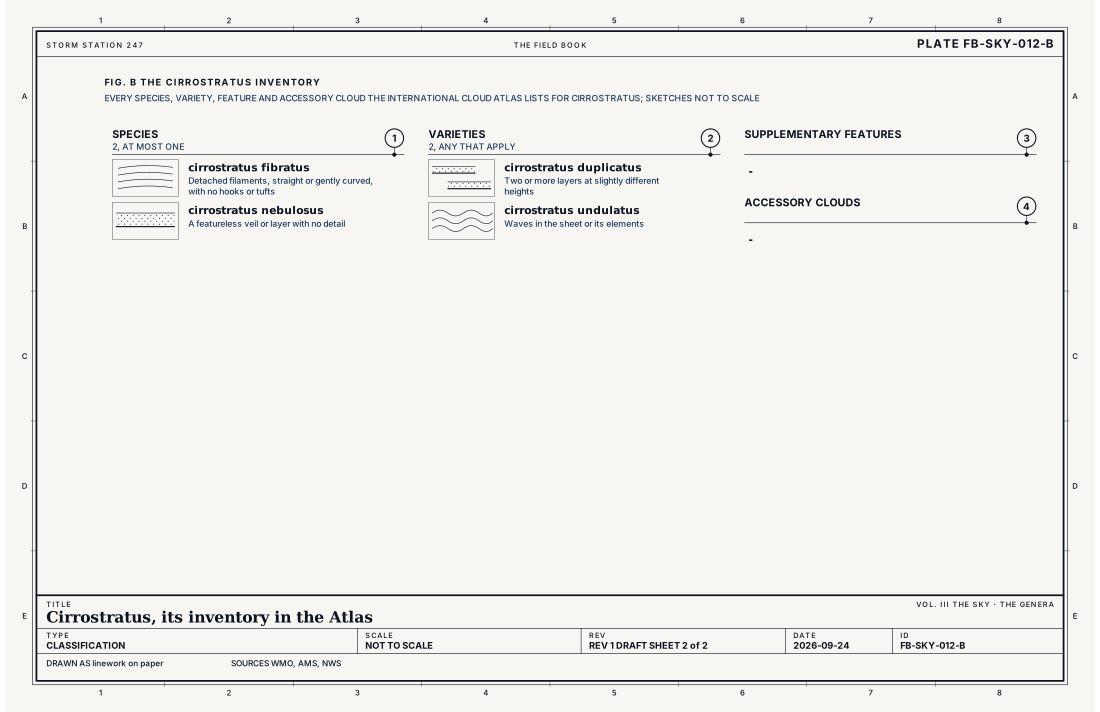
- Species, at most one
- Varieties, any that apply
- Supplementary features, any that apply
- Accessory clouds, any that apply
Ingredients
- A broad, slow lifting of moist air high in the troposphere, as ahead of a warm front
- Temperatures far below freezing, so the cloud is ice
- Six sided ice crystals, which bend light passing through them by 22 degrees
Scales
- time
- hours; it often spreads and thickens over half a day
- horizontal
- hundreds of miles, often the leading edge of a warm front's cloud
- vertical
- a few hundred feet to a mile or more (1.6 km) deep, in the high étage
- orlanski
- synoptic
Signatures
- surface
- the sun or moon ringed by a halo; shadows still cast
- satellite
- a thin cold sheet in the infrared
- radar
- no echo
The numbers
| Quantity | Value, and the kind of number it is |
|---|---|
| Abbreviation | CsStandard, International Cloud Atlas |
| Étage | High: 16,400 to 43,000 ft (5 to 13 km) in the middle latitudesStandard, International Cloud Atlas |
| Made of | Ice crystalsStandard, International Cloud Atlas |
| The halo | A ring of light 22° in radius around the sun or moon, from light refracted through six sided ice crystalsStandard, Glossary of Meteorology |
| Species | 2: fibratus, nebulosusStandard, International Cloud Atlas |
| Varieties | 2: duplicatus, undulatusStandard, International Cloud Atlas |
| Supplementary features | -Standard, International Cloud Atlas |
| Accessory clouds | -Standard, International Cloud Atlas |
| Airport ceilometer | Cloud bases to 12,000 ft (3.7 km) overheadStandard, Automated Surface Observing System (ASOS) User's Guide |
How the station sees it
An airport station measures cloud overhead with a laser ceilometer to 12,000 ft (3.7 km). Cirrostratus stands higher, so the station's own sky report does not carry it; staffed stations add it from sight. Satellites show it as a wide, thin, cold sheet in the infrared images, often the leading edge of a storm's cloud.
- Airport weather stations: cloud overhead to 12,000 ft; this cloud stands higher
How it is warned
Cirrostratus is not warned. Its halo is the oldest weather sign there is, a ring round the moon before rain, and it is right often enough to have lasted: the veil is frequently the first cloud of an approaching front. It is a sign to read the forecast, not a forecast in itself.
See also
- Cloud classification FB-SKY-001
- Cirrus FB-SKY-010
- Altostratus FB-SKY-014
- Halo family FB-SKY-051
- Nimbostratus FB-SKY-015
Sources
- World Meteorological Organization. International Cloud Atlas.
- American Meteorological Society. Glossary of Meteorology.
- National Weather Service. Automated Surface Observing System (ASOS) User's Guide.
Definition after the International Cloud Atlas. Plate FB-SKY-012, revision 1, 2026-09-24. The number is permanent; cite it.