Storm Station 247

The Field Book/Vol. III, The Sky/Cloud classification/FB-SKY-032

Supplementary features atlas

A supplementary feature is a part attached to a cloud or falling from it: an anvil, pouches, falling rain, a shelf, a funnel, a wall. The International Cloud Atlas lists eleven, and a cloud may show any that apply. Four of them are the storm spotter's own words.

Plate FB-SKY-032The ranksRevision 1, 2026-09-25Status draftAlso called supplementary features, incus, anvil, mamma, virga, arcus, shelf cloud, tuba, funnel cloud, wall cloud, murus, asperitas

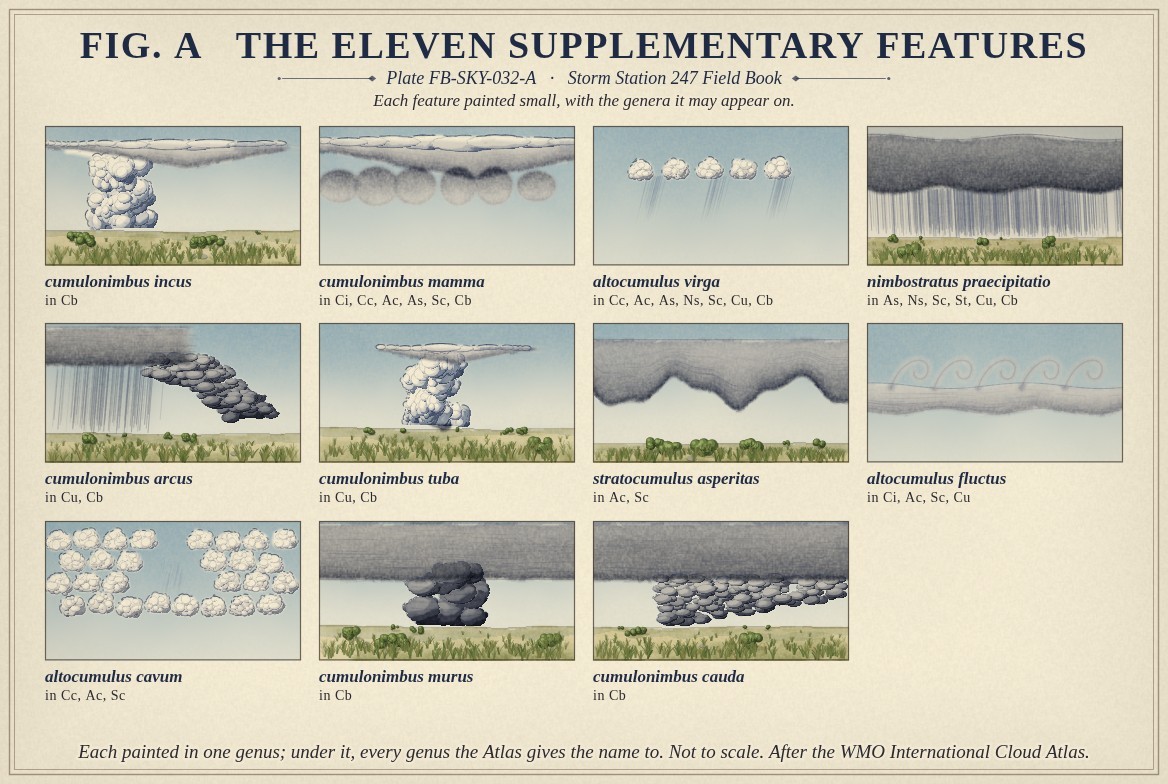
Small paintings of the 11 supplementary features of the International Cloud Atlas, each painted in one genus and labelled with its full name, with every genus the Atlas gives it to beneath: cumulonimbus incus, in cumulonimbus; cumulonimbus mamma, in cirrus, cirrocumulus, altocumulus, altostratus, stratocumulus and cumulonimbus; altocumulus virga, in cirrocumulus, altocumulus, altostratus, nimbostratus, stratocumulus, cumulus and cumulonimbus; nimbostratus praecipitatio, in altostratus, nimbostratus, stratocumulus, stratus, cumulus and cumulonimbus; cumulonimbus arcus, in cumulus and cumulonimbus; cumulonimbus tuba, in cumulus and cumulonimbus; stratocumulus asperitas, in altocumulus and stratocumulus; altocumulus fluctus, in cirrus, altocumulus, stratocumulus and cumulus; altocumulus cavum, in cirrocumulus, altocumulus and stratocumulus; cumulonimbus murus, in cumulonimbus; cumulonimbus cauda, in cumulonimbus.
Fig. A The eleven supplementary features. Each feature painted small, with the genera it may appear on.MaximizeThe drawing, to scale

What it is

A supplementary feature is a part attached to a cloud or falling from it. The International Cloud Atlas lists eleven, drawn in Fig. A with the genera each may appear on, and a cloud may show any that apply. They come after the species and varieties in a name: cumulonimbus capillatus incus is a storm whose fibrous top has spread into an anvil.

Some features are the storm's own. Incus, the anvil, murus, the wall cloud, and cauda, the tail cloud, belong to cumulonimbus FB-SKY-019 alone. Arcus, the shelf or roll cloud, and tuba, the funnel, appear on cumulus and cumulonimbus. Virga is the most widely shared, falling from seven genera. Five were added in 2017: asperitas, fluctus, cavum, murus and cauda.

What it is not

It is not an accessory cloud. An accessory cloud is a separate, smaller cloud seen with the main one, such as a pileus cap or ragged pannus, Accessory clouds FB-SKY-033. Loose scud under a shelf cloud is pannus; a wall cloud is attached to the base and often rotates.

Lookalikes

Accessory clouds
Separate clouds seen with the main one, such as pileus or pannus; see FB-SKY-033
Varieties
Arrangement and transparency of the whole cloud, not parts attached to it
Scud under a shelf
Loose ragged pannus, not attached and not rotating, as a murus is

The machine

Two features are precipitation: virga, streaks that evaporate before they reach the ground, and praecipitatio, rain, snow or hail that does. Five come from a storm's updraft and outflow. The anvil spreads where the updraft meets the tropopause. The shelf rides the cold outflow's leading edge. The wall cloud forms where the updraft draws in moist air from under the rain, Wall cloud FB-SKY-040, and the tail runs into it. A funnel hangs from the base where the air spins fast enough to condense. The rest come from shear and sinking air: fluctus, curls breaking on a layer's top; asperitas, a rough wavy underside; mamma, pouches of sinking cloud; and cavum, a hole where the droplets froze and fell.

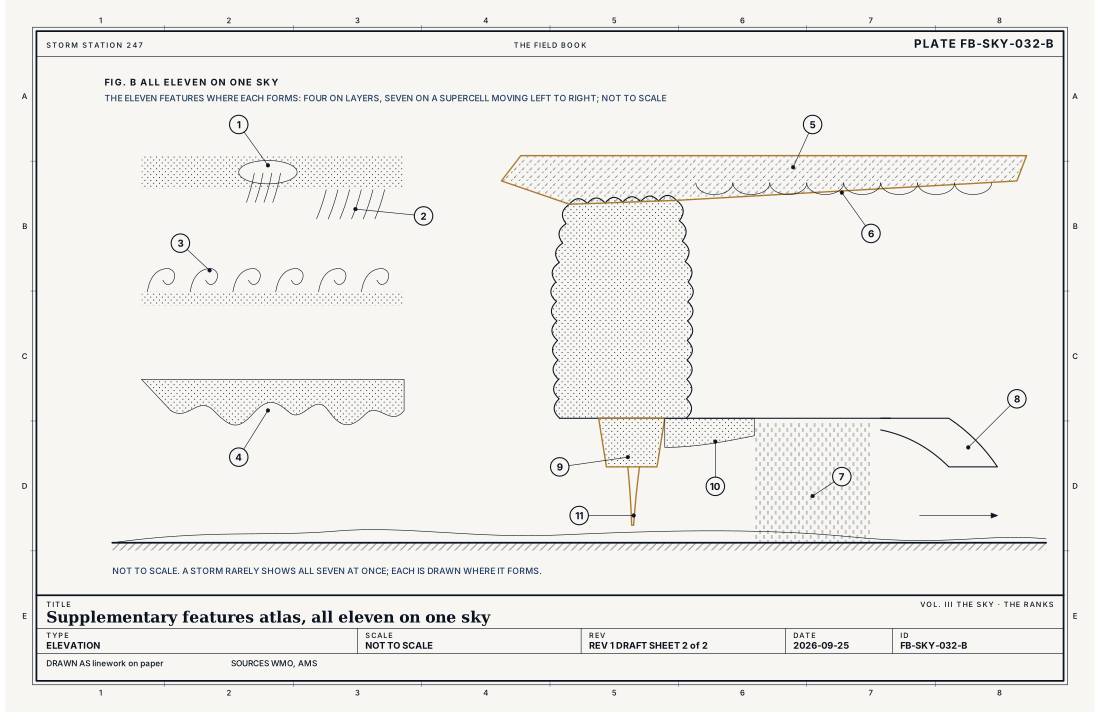
Fig. B draws all eleven where each forms: four on layers, seven on one supercell.
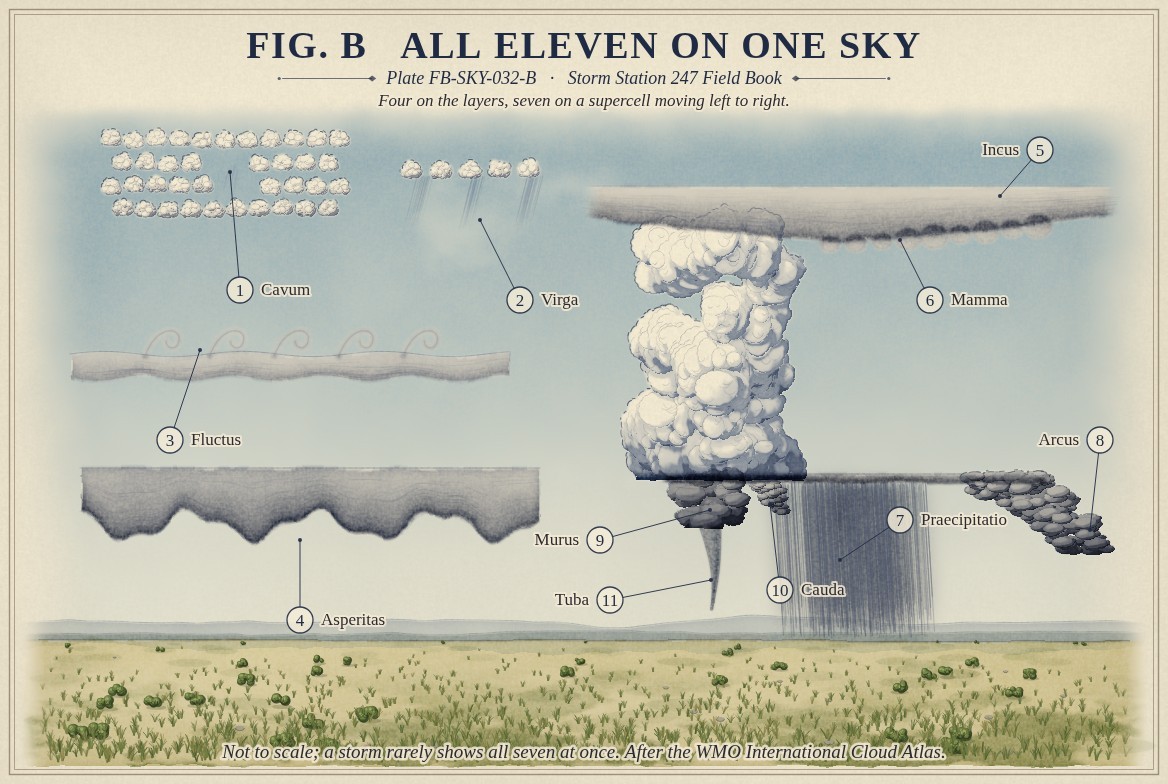
A painted sky, not to scale: on the left, an altocumulus sheet with a round hole of blue sky in it, cavum, and virga trailing from a row of cloudlets; a layer with curls breaking along its top, fluctus; and a stratocumulus with a rough wavy underside, asperitas. On the right, a supercell moving left to right: its flat anvil, incus, with rounded mamma beneath it; a grey rain shaft reaching the ground, praecipitatio; a dark shelf cloud sloping out on its leading edge, arcus; a wall cloud lowered beneath the updraft, murus; a short tail cloud running into it, cauda; and a slender funnel hanging from the wall, tuba.
Fig. B All eleven on one sky. Four on the layers, seven on a supercell moving left to right.MaximizeThe drawing, to scale

The drawings

Each figure drawn as an engineering sheet, its parts numbered, to print at 11 by 17.
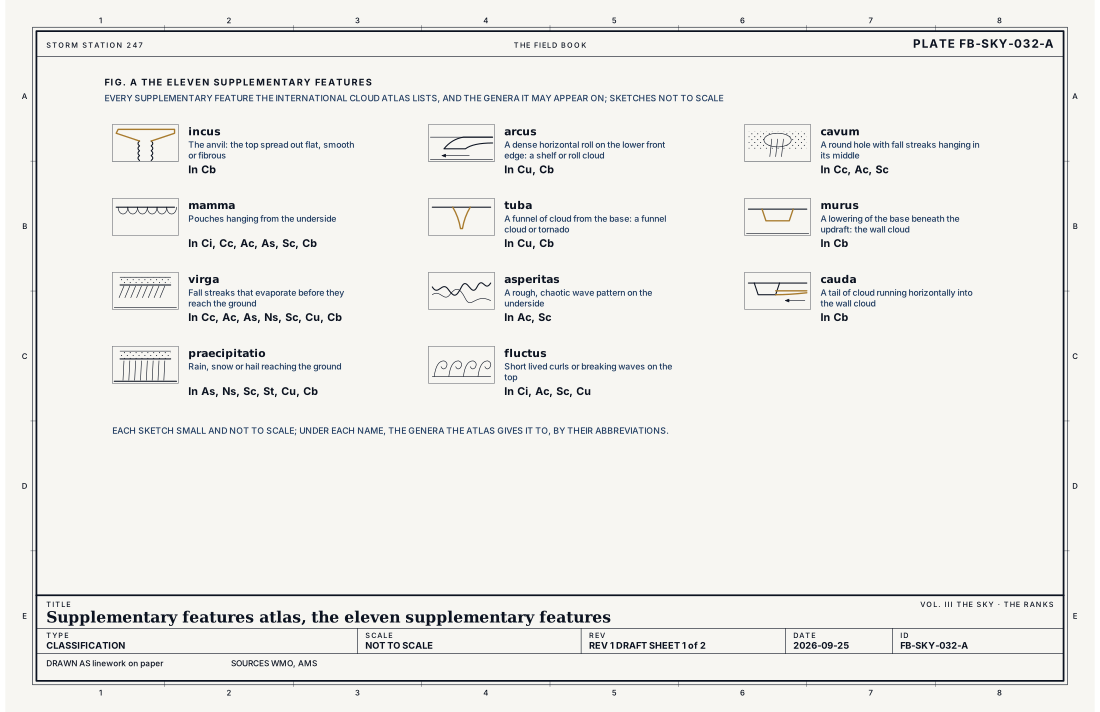
The 11 supplementary features of the International Cloud Atlas, each with a small drafted sketch, one line on what it is, and the genera the Atlas gives it to: incus in cumulonimbus; mamma in cirrus, cirrocumulus, altocumulus, altostratus, stratocumulus and cumulonimbus; virga in cirrocumulus, altocumulus, altostratus, nimbostratus, stratocumulus, cumulus and cumulonimbus; praecipitatio in altostratus, nimbostratus, stratocumulus, stratus, cumulus and cumulonimbus; arcus in cumulus and cumulonimbus; tuba in cumulus and cumulonimbus; asperitas in altocumulus and stratocumulus; fluctus in cirrus, altocumulus, stratocumulus and cumulus; cavum in cirrocumulus, altocumulus and stratocumulus; murus in cumulonimbus; cauda in cumulonimbus.1122334455667788AABBCCDDEESTORM STATION 247THE FIELD BOOKPLATE FB-SKY-032-AEVERY SUPPLEMENTARY FEATURE THE INTERNATIONAL CLOUD ATLAS LISTS, AND THE GENERA IT MAY APPEAR ON; SKETCHES NOT TO SCALEFIG. A THE ELEVEN SUPPLEMENTARY FEATURESincusThe anvil: the top spread out flat, smoothor fibrousIn CbmammaPouches hanging from the undersideIn Ci, Cc, Ac, As, Sc, CbvirgaFall streaks that evaporate before theyreach the groundIn Cc, Ac, As, Ns, Sc, Cu, CbpraecipitatioRain, snow or hail reaching the groundIn As, Ns, Sc, St, Cu, CbarcusA dense horizontal roll on the lower frontedge: a shelf or roll cloudIn Cu, CbtubaA funnel of cloud from the base: a funnelcloud or tornadoIn Cu, CbasperitasA rough, chaotic wave pattern on theundersideIn Ac, ScfluctusShort lived curls or breaking waves on thetopIn Ci, Ac, Sc, CucavumA round hole with fall streaks hanging inits middleIn Cc, Ac, ScmurusA lowering of the base beneath theupdraft: the wall cloudIn CbcaudaA tail of cloud running horizontally intothe wall cloudIn CbEACH SKETCH SMALL AND NOT TO SCALE; UNDER EACH NAME, THE GENERA THE ATLAS GIVES IT TO, BY THEIR ABBREVIATIONS.TITLESupplementary features atlas, the eleven supplementary featuresVOL. III THE SKY · THE RANKSTYPECLASSIFICATIONSCALENOT TO SCALEREVREV 1 DRAFT SHEET 1 of 2DATE2026-09-25IDFB-SKY-032-ADRAWN AS linework on paperSOURCES WMO, AMS
Fig. A, the drawing The eleven supplementary features. Every supplementary feature the International Cloud Atlas lists, and the genera it may appear on; sketches not to scale NOT TO SCALEMaximizeThe sheet, SVG, 11 by 17The painting
  1. incus
  2. mamma
  3. virga
  4. praecipitatio
  5. arcus
  6. tuba
  7. asperitas
  8. fluctus
  9. cavum
  10. murus
  11. cauda
Elevation of one sky, not to scale: on the left, an altocumulus sheet with a round hole and fall streaks in it, cavum, and virga trailing from its edge; a layer with breaking waves on its top, fluctus; and a stratocumulus with a rough wavy underside, asperitas. On the right, a supercell moving left to right: its anvil, incus, with mamma beneath it; rain reaching the ground, praecipitatio; a shelf cloud on its leading edge, arcus; a wall cloud lowered under the updraft, murus; a tail cloud running into the wall, cauda; and a funnel beneath the wall, tuba.1122334455667788AABBCCDDEESTORM STATION 247THE FIELD BOOKPLATE FB-SKY-032-BTHE ELEVEN FEATURES WHERE EACH FORMS: FOUR ON LAYERS, SEVEN ON A SUPERCELL MOVING LEFT TO RIGHT; NOT TO SCALEFIG. B ALL ELEVEN ON ONE SKY1234567891011NOT TO SCALE. A STORM RARELY SHOWS ALL SEVEN AT ONCE; EACH IS DRAWN WHERE IT FORMS.TITLESupplementary features atlas, all eleven on one skyVOL. III THE SKY · THE RANKSTYPEELEVATIONSCALENOT TO SCALEREVREV 1 DRAFT SHEET 2 of 2DATE2026-09-25IDFB-SKY-032-BDRAWN AS linework on paperSOURCES WMO, AMS
Fig. B, the drawing All eleven on one sky. The eleven features where each forms: four on layers, seven on a supercell moving left to right; not to scale NOT TO SCALEMaximizeThe sheet, SVG, 11 by 17The painting
  1. Cavum
  2. Virga
  3. Fluctus
  4. Asperitas
  5. Incus
  6. Mamma
  7. Praecipitatio
  8. Arcus
  9. Murus
  10. Cauda
  11. Tuba

Ingredients

  • Precipitation, which makes virga and praecipitatio
  • The storm's updraft and outflow, which make incus, arcus, murus, cauda and tuba
  • Shear and sinking air across a layer, which make fluctus, asperitas, mamma and cavum

Scales

time
minutes for a funnel or fluctus; an hour or more for an anvil or mamma
horizontal
a few hundred feet for a funnel; tens of miles for an anvil or a shelf
vertical
from a few hundred feet of virga to an anvil at the tropopause
orlanski
micro to meso

Signatures

surface
praecipitatio is the station's own rain, snow or hail; the rest are named from sight
satellite
incus as a wide cold top; the others too small to see from space
radar
praecipitatio and heavy virga echo; a tuba may sit on a rotation couplet

The numbers

QuantityValue, and the kind of number it is
Supplementary features11: incus, mamma, virga, praecipitatio, arcus, tuba, asperitas, fluctus, cavum, murus, caudaStandard, International Cloud Atlas
How many to a cloudAny that applyStandard, International Cloud Atlas
Shared most widelyvirga, in seven generaStandard, International Cloud Atlas
Belonging to cumulonimbus aloneincus, murus and caudaStandard, International Cloud Atlas
Added in 2017asperitas, fluctus, cavum, murus and caudaStandard, International Cloud Atlas
Where the name goesAfter the species and varieties: cumulonimbus capillatus incusStandard, International Cloud Atlas
Airport ceilometerCloud bases to 12,000 ft (3.7 km) overheadStandard, Automated Surface Observing System (ASOS) User's Guide

How the station sees it

Praecipitatio is the one a station measures, as its rain, snow or hail. The others are named from sight. On radar, a funnel may sit over a tight rotation.

How it is warned

A funnel, tuba, that reaches the ground is a tornado, Tornado FB-EVT-009, and a rotating wall cloud is what spotters report first. A shelf cloud marks the gust front of a storm that may bring damaging wind.

See also

Sources

  1. World Meteorological Organization. International Cloud Atlas.
  2. American Meteorological Society. Glossary of Meteorology.

Definition after the International Cloud Atlas. Plate FB-SKY-032, revision 1, 2026-09-25. The number is permanent; cite it.