What it is
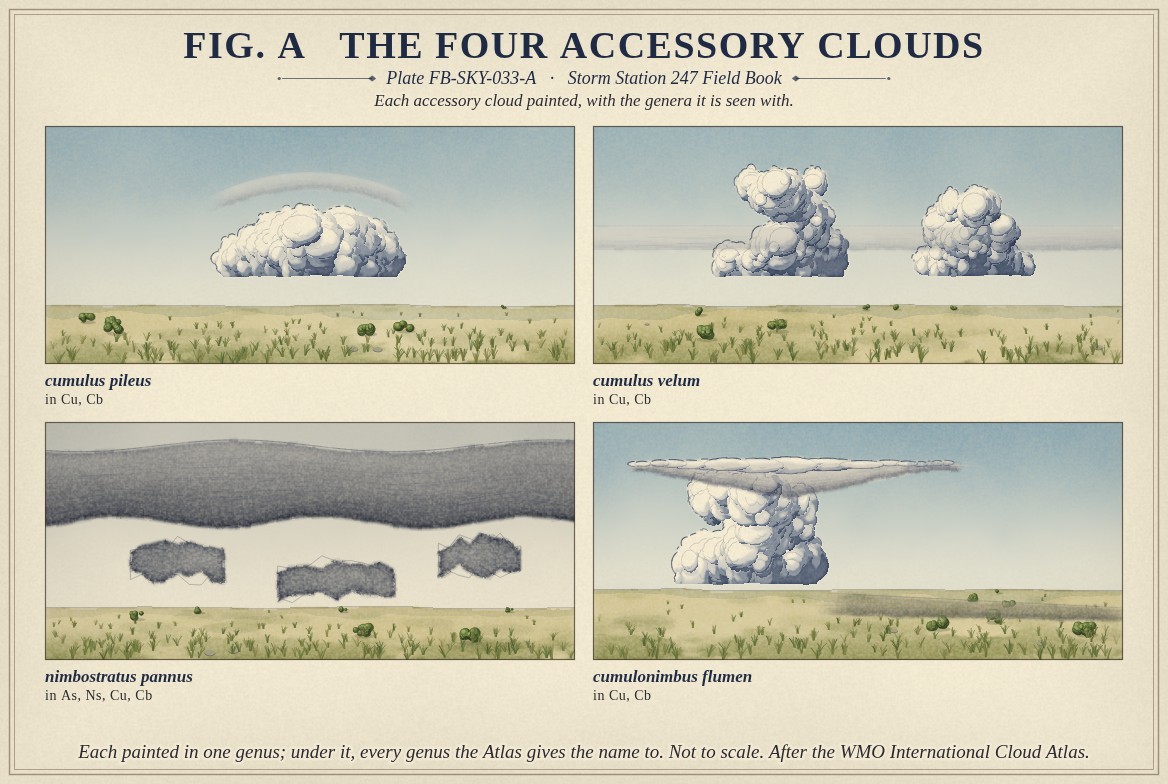
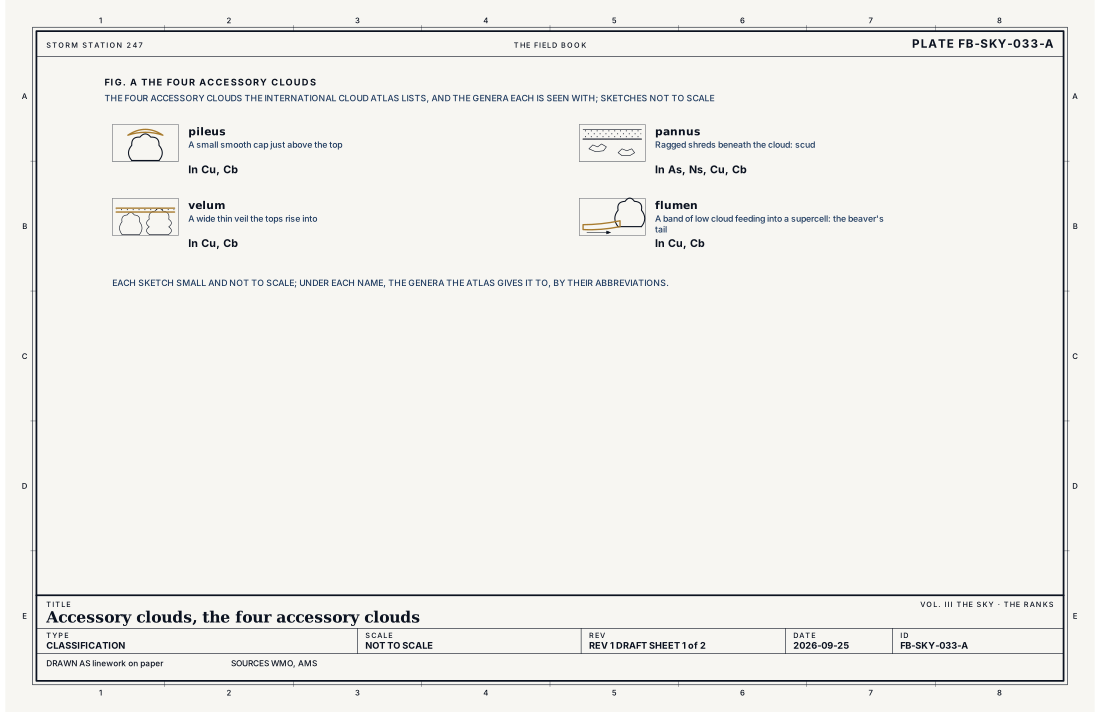
An accessory cloud is a smaller cloud seen with a main one, joined to it or close by. The International Cloud Atlas lists four, drawn in Fig. A with the genera each is seen with, and a cloud may show any that apply. They come last in a name: cumulus congestus pileus is a towering cumulus wearing a cap.
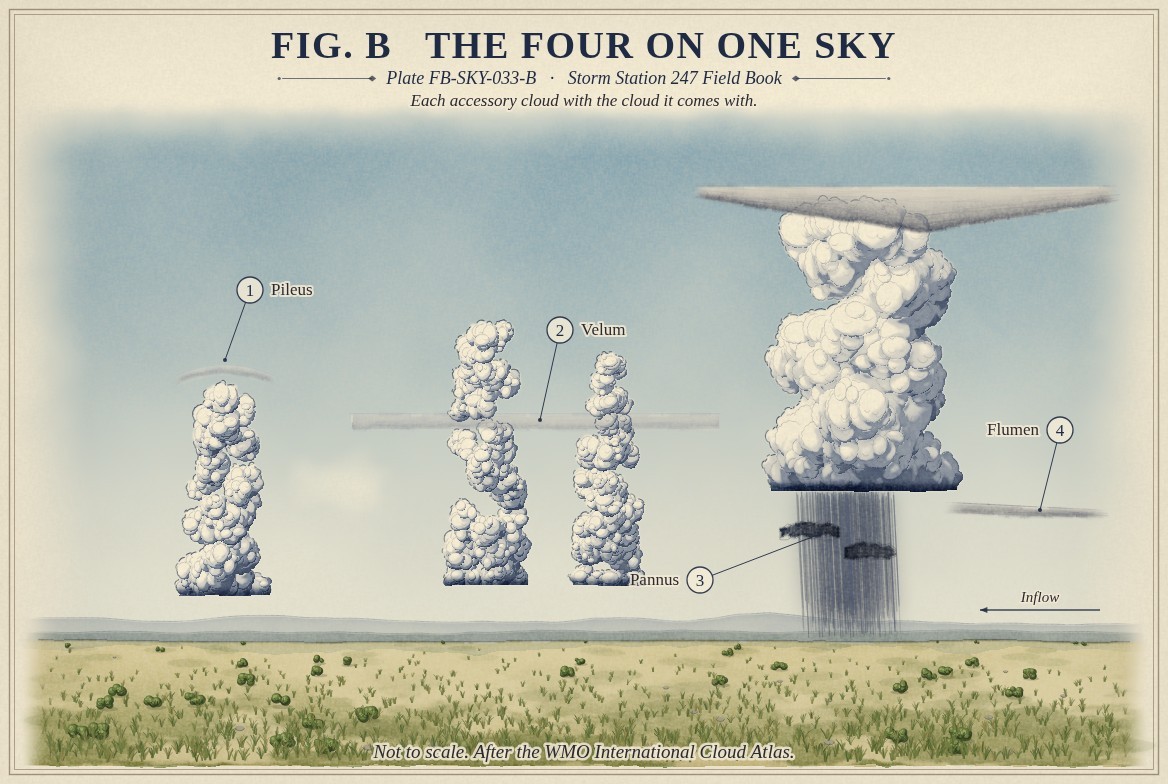
Pileus is a small smooth cap just above a rising top. Velum is a wide thin veil that the tops rise into and often pierce. Pannus is ragged scud beneath a cloud, most often under rain. Flumen is a band of low cloud feeding a storm, known to spotters as the beaver's tail.
What it is not
It is not a supplementary feature, which is a part of the main cloud itself, such as an anvil or a wall cloud, Supplementary features atlas FB-SKY-032. A wall cloud is attached to the base and may rotate; pannus is loose and does not. A lens cloud standing in a mountain wave is altocumulus lenticularis, Orographic clouds FB-SKY-035; a pileus sits on a rising top and moves with it.
Lookalikes
- Supplementary features
- Parts of the main cloud itself, such as an anvil or a wall cloud; see FB-SKY-032
- Wall cloud
- A lowering of the base under the updraft, attached and often rotating; pannus is loose and does not rotate
- Lens cloud
- A lenticularis stands in a mountain wave on its own; a pileus sits on a rising top and is pierced by it
The machine
Pileus and velum form the same way. A strong updraft pushes a moist layer upward ahead of it, the layer cools as it rises, and it condenses into a thin smooth cap. If the layer is wide, the cap is a veil across the tops of many towers; if the updraft keeps rising, it bursts through. Pannus forms under a raining base, where the falling rain moistens the air until it condenses into shreds that drift with the wind. Flumen forms in the moist air flowing into a supercell's updraft from the side of the rain, Cumulonimbus architecture FB-SKY-041.
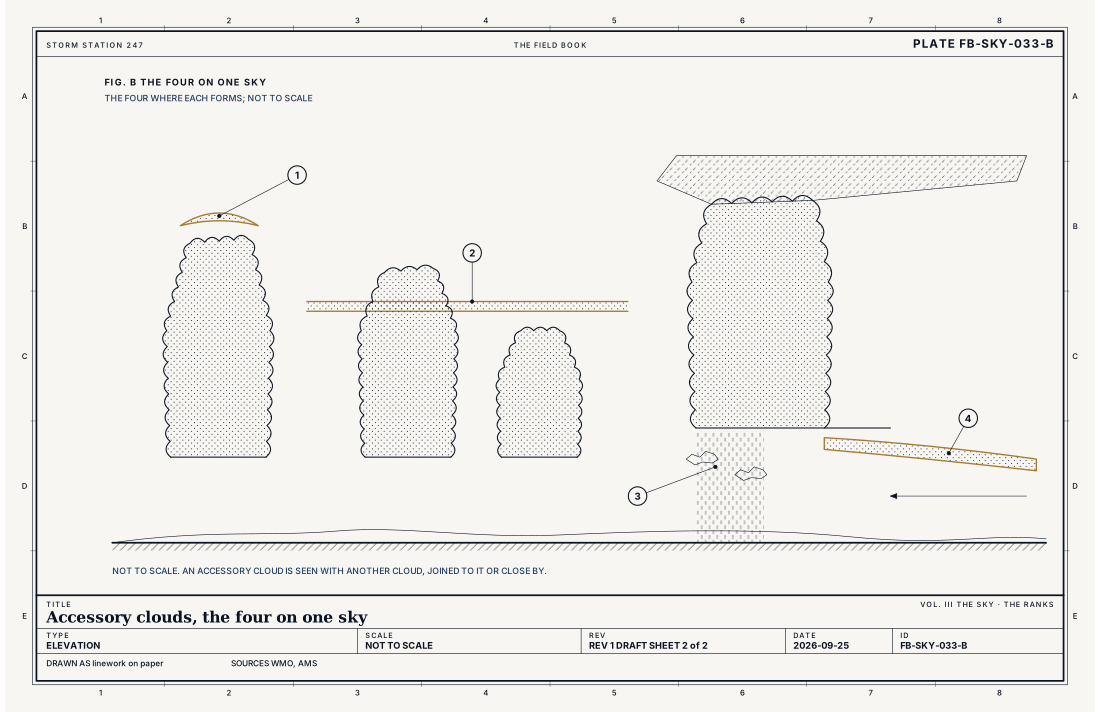
Fig. B draws all four on one sky.
The drawings
Each figure drawn as an engineering sheet, its parts numbered, to print at 11 by 17.
- pileus
- velum
- pannus
- flumen
- Pileus
- Velum
- Pannus
- Flumen
Ingredients
- A rising top that lifts a moist layer above it to saturation: pileus, and velum when the layer is wide
- Rain falling into moist air beneath a base: pannus
- Warm moist air flowing into a supercell's updraft: flumen
Scales
- time
- minutes for a pileus; an hour or more for a velum or flumen
- horizontal
- a cap as wide as the top it sits on; a velum or flumen tens of miles long
- vertical
- a few hundred feet deep
- orlanski
- micro to meso
Signatures
- surface
- low pannus under rain can set a station's lowest layer, often broken or overcast
- satellite
- too small to see, except a velum spread wide over the tops
- radar
- no echo of their own
The numbers
| Quantity | Value, and the kind of number it is |
|---|---|
| Accessory clouds | 4: pileus, velum, pannus and flumenStandard, International Cloud Atlas |
| How many to a cloud | Any that applyStandard, International Cloud Atlas |
| Pannus | With altostratus, nimbostratus, cumulus and cumulonimbusStandard, International Cloud Atlas |
| Pileus and velum | With cumulus and cumulonimbusStandard, International Cloud Atlas |
| Flumen | With cumulus and cumulonimbus; on a supercell, the beaver's tailStandard, International Cloud Atlas |
| Where the name goes | Last: cumulus congestus pileusStandard, International Cloud Atlas |
| Airport ceilometer | Cloud bases to 12,000 ft (3.7 km) overheadStandard, Automated Surface Observing System (ASOS) User's Guide |
How the station sees it
Pannus under rain often sets a station's lowest layer, reported as broken or overcast a few hundred to a few thousand feet up by its ceilometer, which reaches 12,000 ft (3.7 km). The others are named from sight.
- Airport weather stations: the cover and height of each layer overhead, to 12,000 ft
How it is warned
Accessory clouds are not warned. A pileus over a cumulus says its updraft is strong and rising fast. A flumen feeding a storm is one of the signs spotters look for on a supercell.
See also
- Cloud classification FB-SKY-001
- Species atlas FB-SKY-030
- Varieties atlas FB-SKY-031
- Supplementary features atlas FB-SKY-032
- Cumulus FB-SKY-018
- Cumulonimbus FB-SKY-019
- Wall cloud FB-SKY-040
- Cumulonimbus architecture FB-SKY-041
Sources
- World Meteorological Organization. International Cloud Atlas.
- American Meteorological Society. Glossary of Meteorology.
Definition after the International Cloud Atlas. Plate FB-SKY-033, revision 1, 2026-09-25. The number is permanent; cite it.