What it is
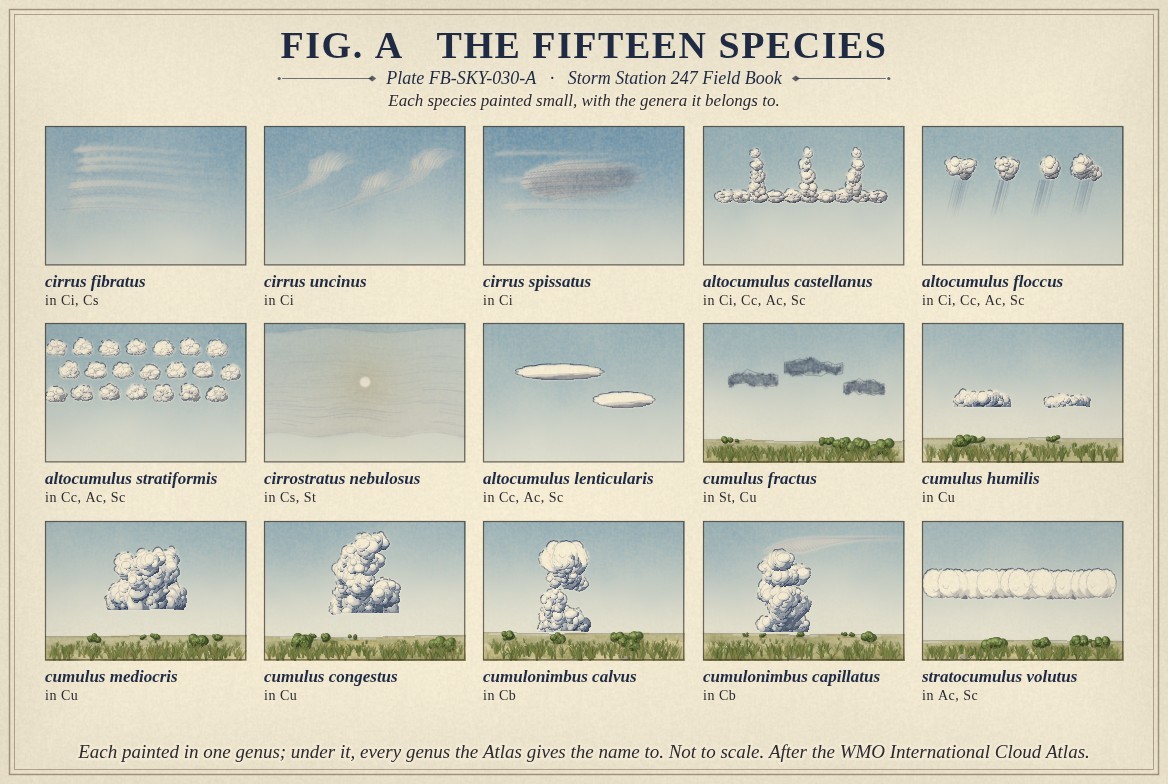
A cloud's species is the second word of its name, after the genus. It says what shape the cloud has, or how it is built inside: in filaments or hooks, in turrets or tufts, in a sheet, a lens, a roll, ragged shreds, or a heap of a given size. The International Cloud Atlas lists fifteen, drawn in Fig. A with the genera each belongs to, and a cloud takes at most one.
Some species belong to a single genus. Uncinus and spissatus are cirrus alone; humilis, mediocris and congestus are the three sizes of cumulus FB-SKY-018; calvus and capillatus are the two stages of a cumulonimbus FB-SKY-019 top. Others are shared: castellanus and floccus appear in four genera, from cirrus down to stratocumulus. Altostratus and nimbostratus have no species at all.
What it is not
It is not the variety, which says how a cloud's parts are arranged and how much light it lets through, Varieties atlas FB-SKY-031. A cloud has one species but may carry several varieties. Nor is it a supplementary feature, a part attached to the cloud such as an anvil, Supplementary features atlas FB-SKY-032.
Lookalikes
- Varieties
- Arrangement and transparency, not shape; a cloud can have several at once
- Supplementary features
- Parts attached to a cloud, like an anvil or mamma; see FB-SKY-032
- Genus
- The first rank, one of ten; the species narrows it
The machine
Each species records how the air moves in the cloud. Turrets and tufts, castellanus and floccus, mean the air at that height is unstable and overturning, often a sign that showers and storms may follow later in the day. A lens, lenticularis, stands still in a wave of air downwind of mountains. A sheet, stratiformis, is a layer lifted broadly. The heaps of cumulus grow from humilis through mediocris to congestus as the updraft deepens, and a cumulonimbus goes from calvus to capillatus as its top turns to ice.
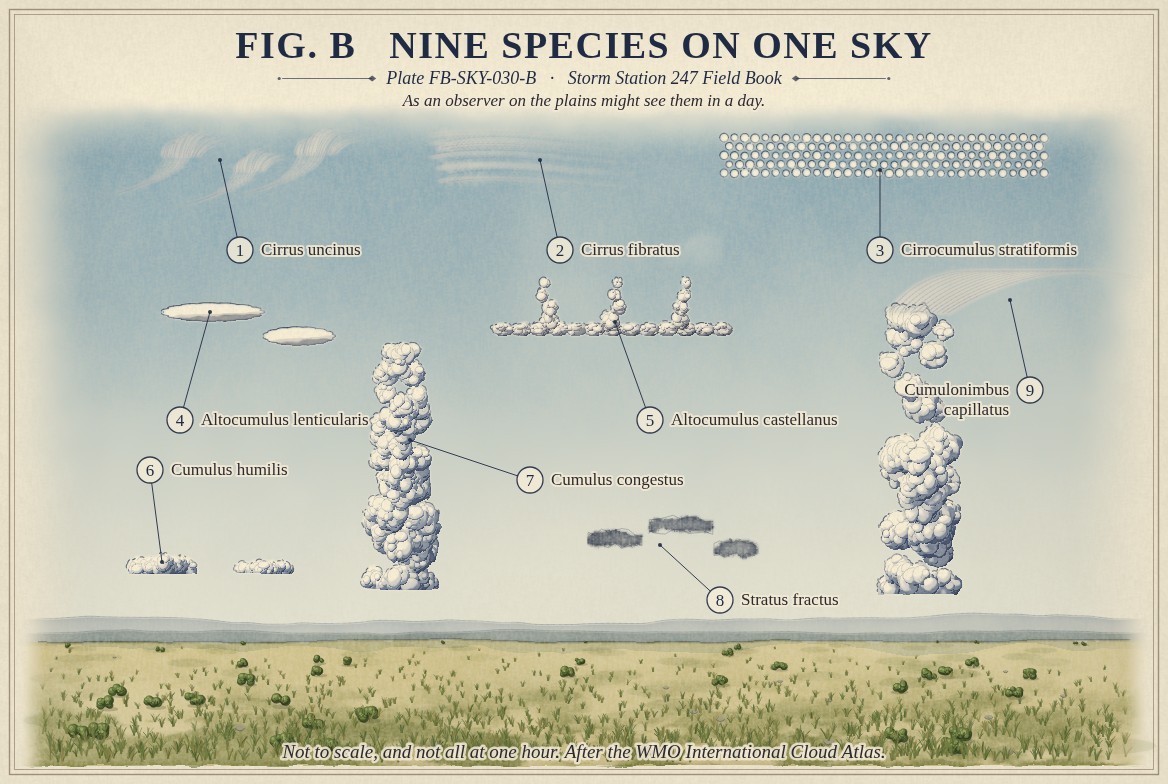
Fig. B puts nine of the fifteen on one sky over the plains, as an observer might see them over a day.
The drawings
Each figure drawn as an engineering sheet, its parts numbered, to print at 11 by 17.
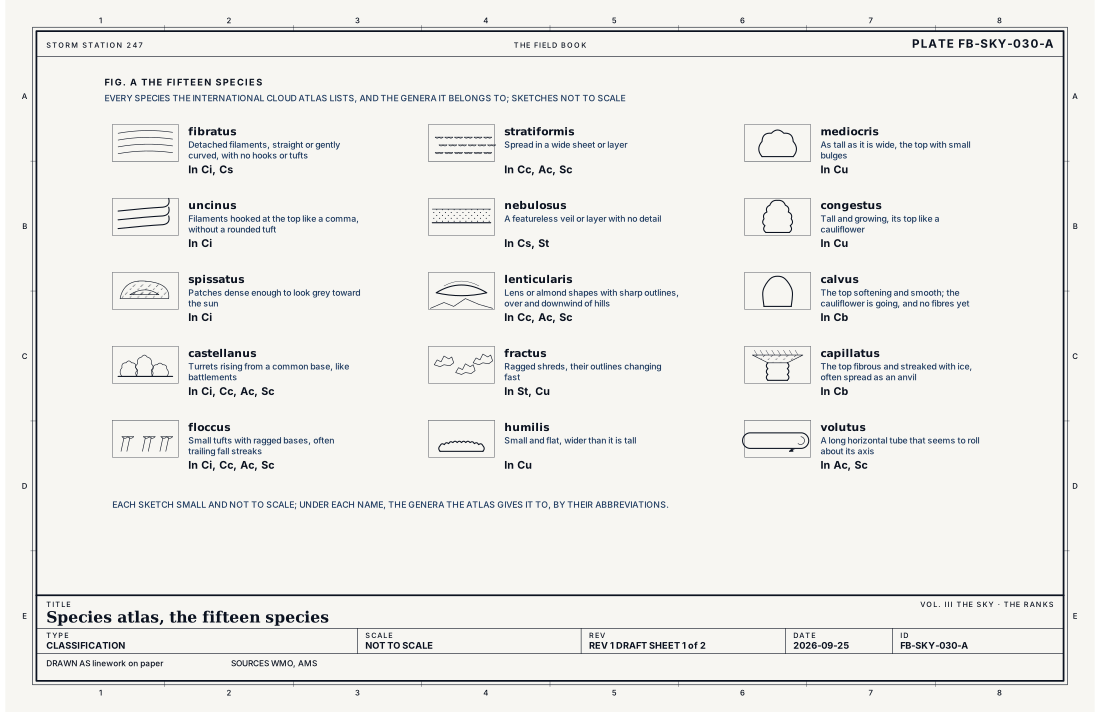
- fibratus
- uncinus
- spissatus
- castellanus
- floccus
- stratiformis
- nebulosus
- lenticularis
- fractus
- humilis
- mediocris
- congestus
- calvus
- capillatus
- volutus
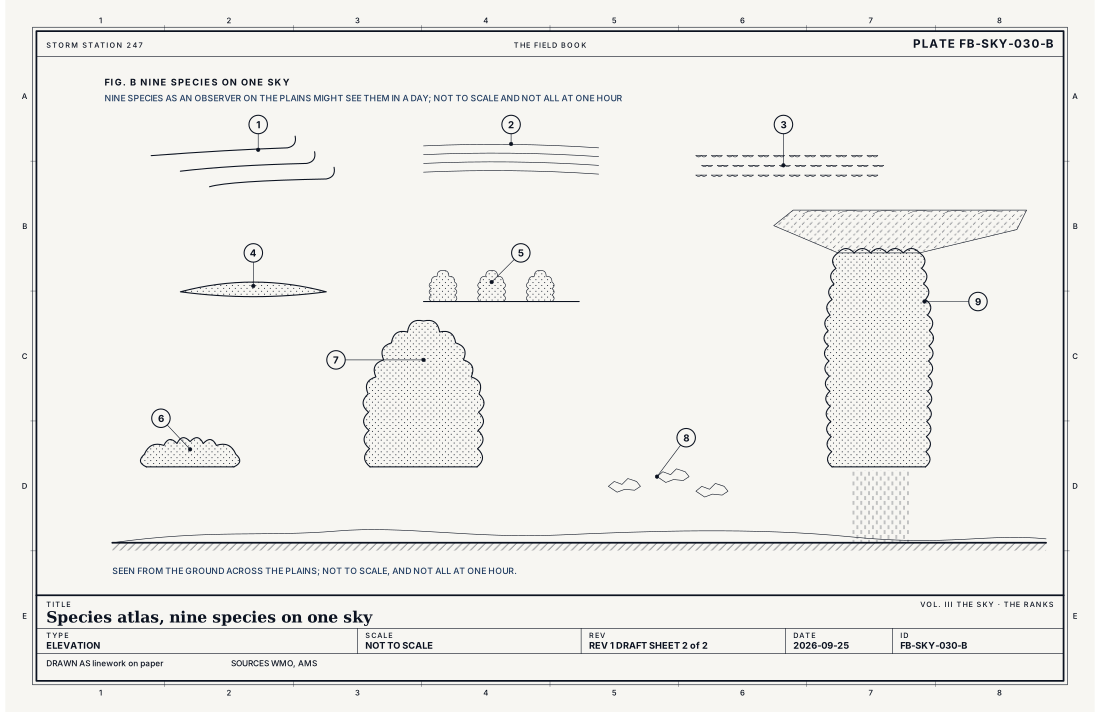
- Cirrus uncinus
- Cirrus fibratus
- Cirrocumulus stratiformis
- Altocumulus lenticularis
- Altocumulus castellanus
- Cumulus humilis
- Cumulus congestus
- Stratus fractus
- Cumulonimbus capillatus
Ingredients
- The shape of a cloud, which the species names
- How the air moves inside it: turrets and tufts where it overturns, lenses where it waves, sheets where it is lifted broadly
- Growth over time, which moves a cloud from one species to the next
Scales
- time
- a species can change within minutes, as a mediocris grows into a congestus
- horizontal
- from a single turret to a sheet hundreds of miles across
- vertical
- from a flat humilis a few hundred feet deep to a capillatus through all three étages
- orlanski
- micro to synoptic
Signatures
- surface
- named by an observer from sight; an airport station reports cover and height, not species
- satellite
- lenticularis stands still downwind of mountains; congestus and capillatus show as growing, then cold, tops
- radar
- congestus may show a first echo; capillatus usually rains
The numbers
| Quantity | Value, and the kind of number it is |
|---|---|
| Species | 15: fibratus, uncinus, spissatus, castellanus, floccus, stratiformis, nebulosus, lenticularis, fractus, humilis, mediocris, congestus, calvus, capillatus, volutusStandard, International Cloud Atlas |
| How many to a cloud | At most oneStandard, International Cloud Atlas |
| Shared most widely | castellanus and floccus, each in four genera: cirrus, cirrocumulus, altocumulus and stratocumulusStandard, International Cloud Atlas |
| Belonging to one genus | uncinus and spissatus (cirrus); humilis, mediocris and congestus (cumulus); calvus and capillatus (cumulonimbus)Standard, International Cloud Atlas |
| Genera with no species | altostratus and nimbostratusStandard, International Cloud Atlas |
| Where the name goes | After the genus: altocumulus lenticularisStandard, International Cloud Atlas |
| Airport ceilometer | Cloud bases to 12,000 ft (3.7 km) overheadStandard, Automated Surface Observing System (ASOS) User's Guide |
How the station sees it
An airport station measures the height and cover of each layer overhead with a ceilometer, up to 12,000 ft (3.7 km). It does not name the species. An observer adds TCU for towering cumulus, a congestus, and CB for a cumulonimbus.
- Airport weather stations: the cover and height of each layer overhead, to 12,000 ft
How it is warned
Species are not warned. Two of them are worth watching: altocumulus castellanus on a summer morning, which says the middle air is unstable, and cumulus congestus, the step before a thunderstorm.
See also
- Cloud classification FB-SKY-001
- Varieties atlas FB-SKY-031
- Supplementary features atlas FB-SKY-032
- Accessory clouds FB-SKY-033
- Cirrus FB-SKY-010
- Altocumulus FB-SKY-013
- Cumulus FB-SKY-018
- Cumulonimbus FB-SKY-019
Sources
- World Meteorological Organization. International Cloud Atlas.
- American Meteorological Society. Glossary of Meteorology.
Definition after the International Cloud Atlas. Plate FB-SKY-030, revision 1, 2026-09-25. The number is permanent; cite it.