What it is
Everything glows, and the hotter it is the more it glows and the shorter the waves it glows in. The sun, at 9,930 °F (5,772 K), glows mostly in visible light. The Earth, far colder, glows in the infrared, where the eye cannot see. The radiation budget is the account between the two: the sunlight coming in, and the Earth's own glow going out.
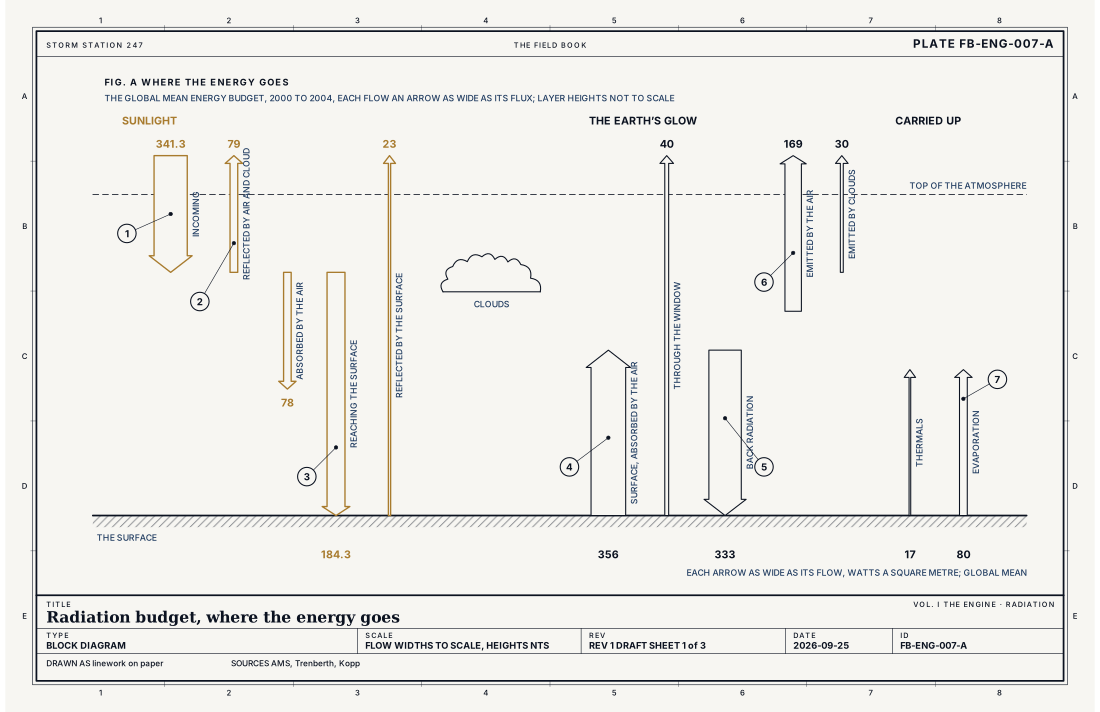
Averaged over the whole globe and the whole year, the two nearly balance. Fig. A draws the account in watts a square metre, each arrow as wide as its flow. Of 341.3 arriving at the top of the atmosphere, 101.9 is reflected straight back, 79 by the air and clouds and 23 by the surface. The air absorbs 78, and 161 is absorbed at the surface. To balance, the Earth sends 238.5 back to space as its glow. The last 0.9 is kept, and the Earth warms.
What it is not
It is not the same at every place or hour. The tropics take in more sunlight than they send out, and the poles send out more than they take in. The winds and ocean currents carry the difference toward the poles, and that carrying is the weather.
It is not the ozone hole. That is a thinning of ozone in the stratosphere, which lets through more ultraviolet light, a separate matter.
Lookalikes
- Heat
- Heat moves by radiation, by contact and by rising air; this plate follows all three but counts them in the radiation's units, watts a square metre.
- The ozone hole
- A thinning of stratospheric ozone that lets more ultraviolet through; a separate matter from the greenhouse effect.
- Weather
- The budget is a global average over years; weather is the budget out of balance from place to place and hour to hour.
The machine
Two kinds of light
Fig. B draws the two spectra. Sunlight peaks at 0.50 micrometres, in the middle of the visible band; the Earth's glow peaks near 11.4 micrometres. They barely overlap, parting near 4 micrometres, and so the budget divides cleanly: shortwave in, longwave out. The difference matters because the air treats them differently. It lets most sunlight through, but water vapour, carbon dioxide and clouds absorb most of the Earth's glow, Composition of air FB-ENG-002.
The Earth seen from space
The first equation below asks how warm the Earth would look to an instrument in space. The sun delivers 1,361 W m⁻² at the Earth's distance. About 30 per cent is reflected, and the rest, spread over the whole sphere, is 238 W m⁻². A black body that radiates that much is at 255 K, about −1 °F (−18 °C). The surface averages 59 °F (15 °C), about 60 °F (33 °C) warmer. That difference is the greenhouse effect.
Why the surface is warmer
The air absorbs the surface's glow and glows in turn, both upward and back down. Fig. A shows the result: the surface receives 333 W m⁻² from the air, about twice what it absorbs from the sun. The second equation below is the simplest model of it, one layer of air, drawn in Fig. C. A layer absorbing all the glow would warm the surface to 85 °F (30 °C); one absorbing 78 per cent gives 59 °F (15 °C), the observed mean. The real surface also loses heat without radiation: 17 W m⁻² in rising thermals and 80 in evaporation, which returns as heat when the vapour condenses in clouds.
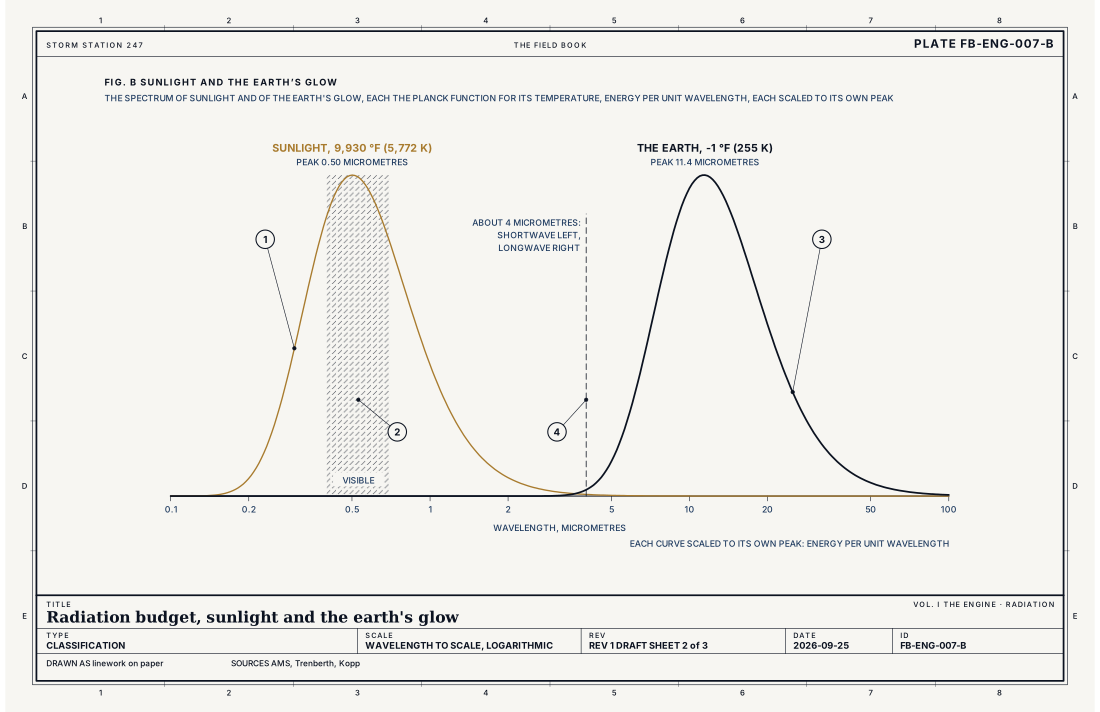
- Sunlight
- The visible band
- The Earth's glow
- Where they part, about 4 micrometres
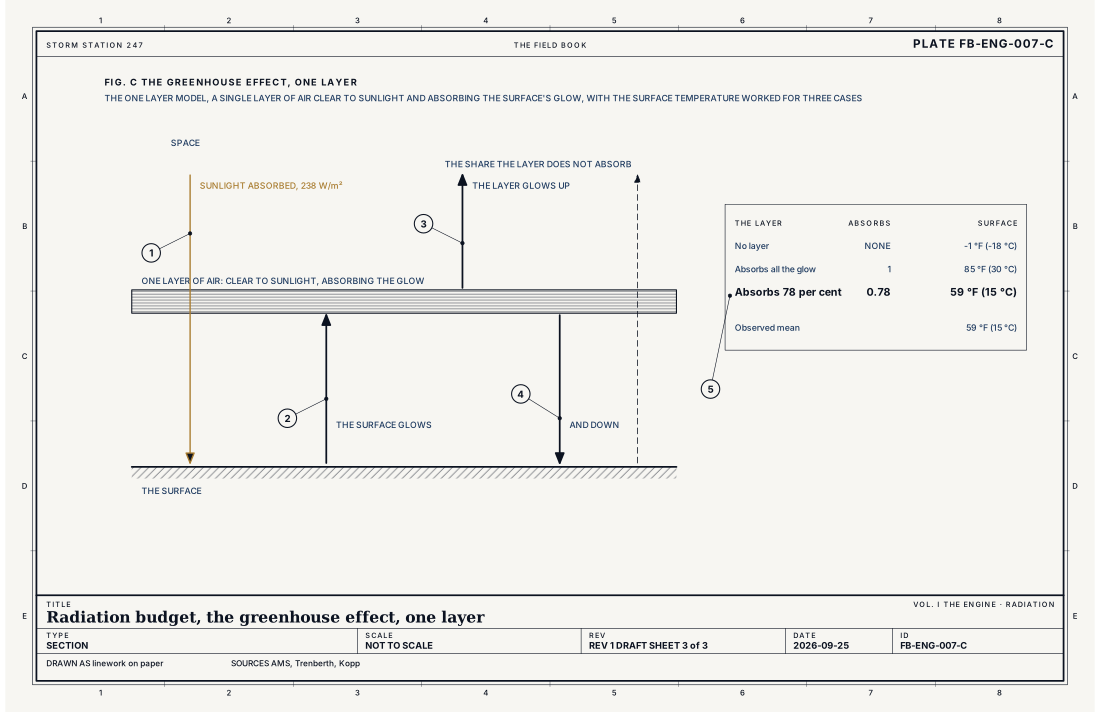
- Sunlight, through the layer
- The surface's glow
- The layer's glow, up to space
- The layer's glow, down to the surface
- The surface temperature for a layer absorbing 78 per cent
Ingredients
- Sunlight, most of its energy at short wavelengths the air lets through
- The Earth's own glow, at long wavelengths the air's water vapour, carbon dioxide and clouds absorb
- Clouds, snow and ice, which reflect sunlight straight back to space
- Rising air and evaporation, which carry heat up from the surface without radiation
Scales
- time
- the budget balances over a year; each day and each season it runs a surplus or a deficit
- horizontal
- the whole planet; each place runs its own budget, in surplus near the equator and in deficit near the poles
- vertical
- the whole depth of the atmosphere, from the ground to the top of the atmosphere
- orlanski
- planetary
Equations
The Earth seen from space
- the Earth intercepts sunlight on a disc and spreads it over a sphere four times the disc's area
- the Stefan Boltzmann constant, 5.67 × 10⁻⁸ W m⁻² K⁻⁴
- the temperature of a black body that radiates what the Earth sends to space, K
- the sunlight at the Earth's distance, 1,361 W m⁻²
- the share of sunlight reflected, about 0.30
Assumes The whole Earth as one body in balance, radiating like a black body; the averages over the globe and the year.
Working form The Earth absorbs 1,361 × 0.70 ÷ 4 = 238 W m⁻² and sends 238.5 W m⁻² to space. A black body that radiates that much is at 255 K, about −1 °F (−18 °C). The surface averages 59 °F (15 °C), about 60 °F (33 °C) warmer: the greenhouse effect.
One layer of air
- the surface temperature, K
- the temperature the Earth shows to space, K
- the share of the surface's glow the layer absorbs, between 0 and 1
Assumes The textbook one layer model; the air as a single layer clear to sunlight, absorbing a share of the surface's glow and glowing up and down alike. It leaves out convection and evaporation, which carry heat up in the real atmosphere.
Working form With no layer the surface would be −1 °F (−18 °C). A layer absorbing all the glow gives 85 °F (30 °C); one absorbing 78 per cent gives 59 °F (15 °C), the observed mean.
Signatures
- sounding
- surface
- the day's warming while the sun is up and the night's cooling after; clear; dry nights cooling most; cloudy; humid nights least
- satellite
- bright cloud and snow in visible images; reflecting sunlight; cold cloud tops in infrared images; glowing little to space
- radar
The numbers
| Quantity | Value, and the kind of number it is |
|---|---|
| Total solar irradiance | 1,361 W m⁻², the sunlight on a surface facing the sun at the Earth's mean distanceTextbook, Kopp 2011 |
| Global mean energy budget | 341.3 W m⁻² in; 101.9 reflected; 238.5 sent to space as the Earth's glow; 0.9 kept, warming the Earth, 2000 to 2004Textbook, Trenberth 2009 |
| At the surface | 161 absorbed from the sun and 333 back radiation from the air in; 396 glow, 80 evaporation and 17 thermals out, W m⁻²Textbook, Trenberth 2009 |
| Albedo | The share of sunlight reflected; the Earth's is about 0.30Standard, Glossary of Meteorology |
| Greenhouse effect | The heating of the surface by the air's absorbing and re-emitting the surface's glowStandard, Glossary of Meteorology |
How the station sees it
A station sees the budget of its own spot, hour by hour. By day the sun's side wins and the temperature climbs; after sunset the glow wins and it falls. Clouds change both sides: they reflect sunlight, so a cloudy day stays cooler, and they glow back down, so a cloudy night stays warmer. A clear, dry, calm night loses the most heat to space, and that is when frost and fog form, Fog types FB-WAT-020.
Satellites see the budget from above, Geostationary satellite FB-INS-006. Visible images show what is reflected; infrared images show the glow, cold cloud tops glowing least.
- Airport weather stations: the temperature and the sky cover each minute, the day's warming and the night's cooling
- Cooperative observers: the day's high and low, the long record of the surface's side of the budget
How it is warned
The budget is not warned. Its daily swing sits under every frost advisory, heat warning and fog forecast: each is a place where the budget has run far out of balance for a night or for a week.
See also
- Atmosphere in section FB-ENG-001
- Composition of air FB-ENG-002
- Water vapour as a gas FB-ENG-011
- Seasons FB-CLK-001
- Sun and insolation FB-CLK-002
- Day and night FB-CLK-004
- Geostationary satellite FB-INS-006
- Fog types FB-WAT-020
Sources
- American Meteorological Society. Glossary of Meteorology.
- Trenberth, K. E., J. T. Fasullo and J. Kiehl. Earth's Global Energy Budget, Bulletin of the American Meteorological Society 90 (2009).
- Kopp, G. and J. L. Lean. A new, lower value of total solar irradiance, Geophysical Research Letters 38 (2011).
- Wallace, J. M. and P. V. Hobbs. Atmospheric Science, An Introductory Survey, 2nd ed. (2006).
Definition after the Glossary of Meteorology. Plate FB-ENG-007, revision 1, 2026-09-25. The number is permanent; cite it.