What it is
Air has weight, and the atmosphere holds itself up. Take any slab of air, a thin layer one square foot across. Gravity pulls it down with its weight. The air below it pushes up on its underside, and the air above pushes down on its top. The pressure below is a little greater than the pressure above, and the difference is exactly the slab's weight. That is hydrostatic balance, and it holds in almost every slab of air at almost every moment.
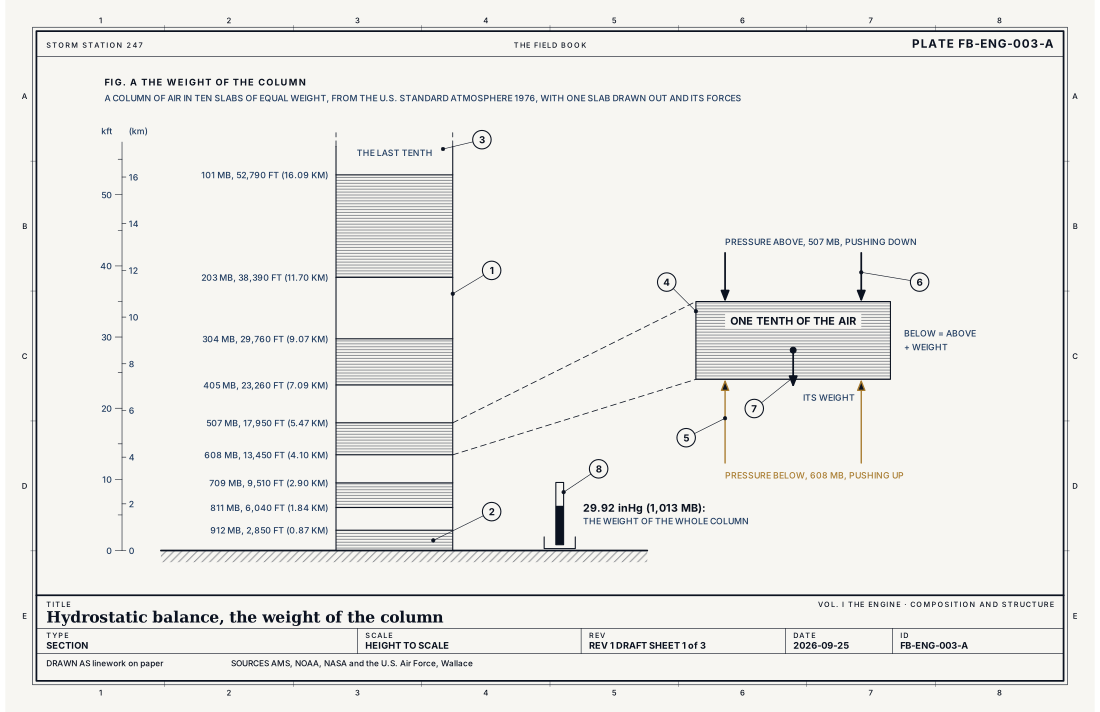
Stack the slabs and the rule gives the most useful fact in meteorology: the pressure at any level is the weight of all the air above it. At sea level in the standard atmosphere that weight is 29.92 inHg (1,013 mb). Fig. A cuts the column into ten slabs of equal weight. The bottom one is 2,850 ft (0.87 km) thick; each slab above is thicker, because the air in it is squeezed less; and the last tenth of the air lies above 52,790 ft (16.09 km).
What it is not
It is not stillness. A column in hydrostatic balance can carry the jet stream through it at 150 mph (67 m/s). The balance is up and down, and says nothing about the wind blowing sideways, which has its own balance, Geostrophic and thermal wind FB-ENG-009.
It is not true everywhere. Inside the strongest thunderstorm updrafts the air speeds upward, and the balance breaks for a few minutes over a few miles. Everywhere else the error is too small to measure.
Lookalikes
- Stillness
- A column in hydrostatic balance can carry a 150 mph (67 m/s) jet stream. The balance is up and down; the wind is sideways.
- Geostrophic balance
- The sideways balance between the pressure gradient and the turn of the Earth, which sets the wind aloft. Both hold at once in most of the atmosphere.
- A thunderstorm updraft
- Inside the strongest updrafts the air accelerates upward and the balance breaks, for a few minutes and a few miles.
The machine
How fast the pressure falls
The first equation below says the pressure falls with height at a rate set by the air's density. Near sea level the air weighs 0.0765 lb a cubic foot (1.225 kg a cubic metre), and the pressure falls 1 mb for each 27 ft (8.3 m) of climb. Near 18,000 ft (5.5 km) the air is little more than half as dense, and it takes 48 ft (14.6 m) to lose a millibar. So the pressure falls fast near the ground and slower aloft, and half the air lies below 17,950 ft (5.47 km), the fifth boundary in Fig. A, Atmosphere in section FB-ENG-001.
Warm layers are thick
Combine the balance with the gas law and it gives the second equation, the hypsometric equation: the thickness of the layer between two pressures depends only on the layer's mean temperature. Warm air takes more room for the same weight. A layer from 1,000 to 500 mb averaging 19 °F (−7 °C) is 17,700 ft (5,400 m) thick, and each degree Fahrenheit warmer adds 37 ft (11.3 m).
Fig. B draws the consequence. A cold column averaging 5 °F (−15 °C) is 17,180 ft (5,238 m) thick; a warm one averaging 32 °F (0 °C) is 18,180 ft (5,542 m). With the same pressure at the ground, the 500 mb surface stands about 1,000 ft (304 m) lower over the cold air. That slope is what drives the wind aloft: in the Northern Hemisphere, with the cold air to the north, it blows from the west. This is why forecasters draw thickness on their charts. A thin layer is a cold layer.
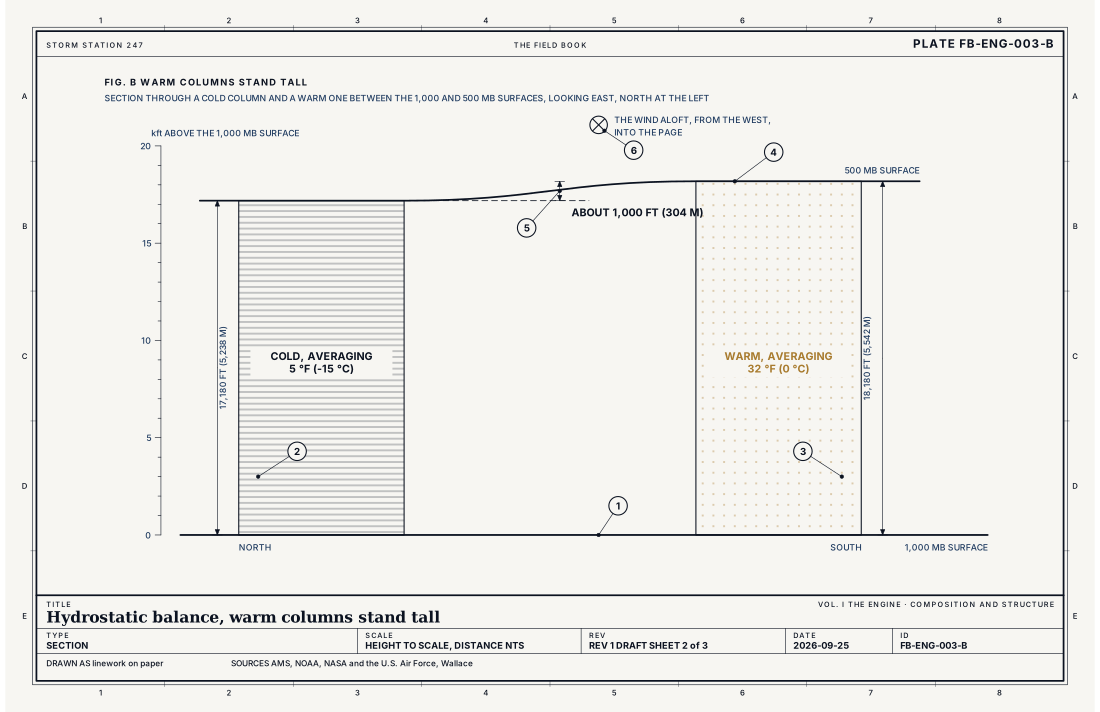
- The 1,000 mb surface
- The cold column
- The warm column
- The 500 mb surface, sloping down toward the cold
- The difference, about 1,000 ft (304 m)
- The wind aloft, into the page
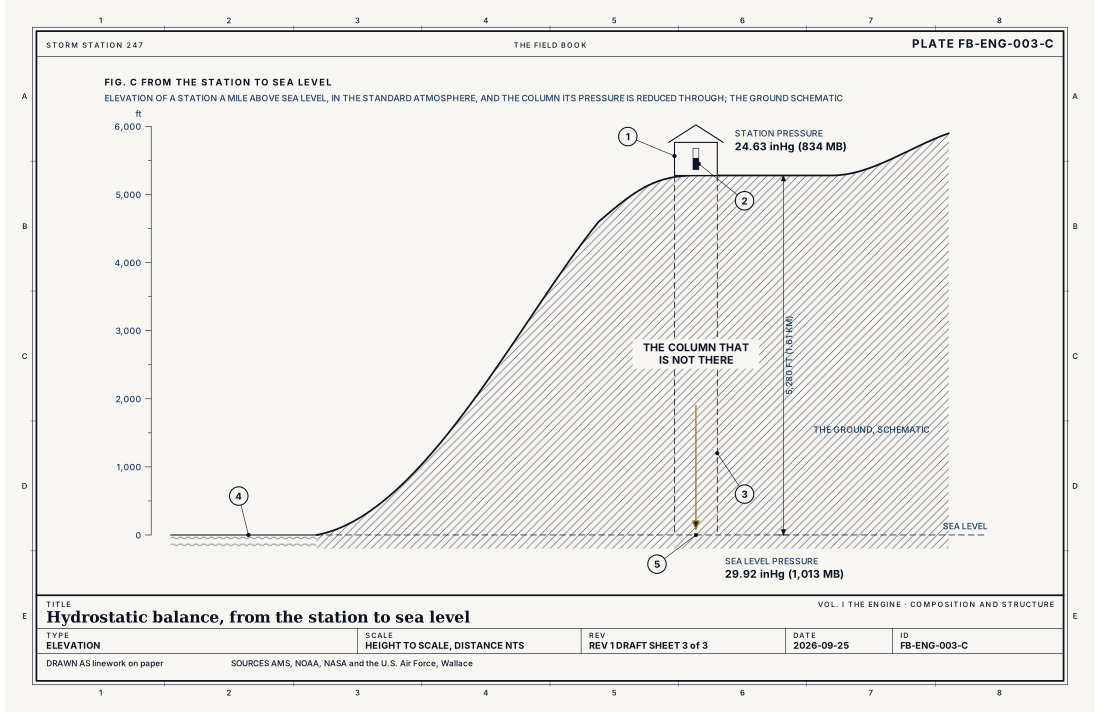
- The station, a mile up
- Its barometer, the station pressure
- The column that is not there
- Sea level
- The sea level pressure
Ingredients
- Gravity, pulling each slab of air down with its weight
- Pressure, which falls with height, so a slab is pushed up harder from below than down from above
- Temperature, which sets how much room a slab of a given weight takes up
Scales
- time
- always; it is broken only for minutes, inside the strongest updrafts
- horizontal
- every column of air, from a few miles (a few km) across to the whole planet
- vertical
- the whole depth of the atmosphere
- orlanski
- planetary
Equations
The hydrostatic equation
- the pressure, Pa
- the height, m
- the density of the air, kg m⁻³
- gravity, 9.81 m s⁻²
Assumes The air's vertical acceleration is small beside gravity, true everywhere but inside the strongest updrafts and downdrafts.
Working form At sea level in the standard atmosphere the air weighs 0.0765 lb a cubic foot (1.225 kg a cubic metre), and the pressure falls 1 mb for each 27 ft (8.3 m) of height; near 18,000 ft (5.5 km), where the air is about half as dense, it takes 48 ft (14.6 m).
The hypsometric equation
- the thickness of the layer between the pressures p_1 below and p_2 above, m
- the gas constant for dry air, 287 J kg⁻¹ K⁻¹
- the mean virtual temperature of the layer, K; the temperature, raised slightly for the water vapour the air holds
- gravity, 9.81 m s⁻²
Assumes The hydrostatic equation integrated with the gas law; the layer's temperature enters only as its mean.
Working form A layer from 1,000 to 500 mb averaging 19 °F (−7 °C) is 17,700 ft (5,400 m) thick; each degree Fahrenheit warmer adds 37 ft (11.3 m). At 5 °F (−15 °C) it is 17,180 ft (5,238 m) thick, and at 32 °F (0 °C) 18,180 ft (5,542 m).
Signatures
- sounding
- the height of each pressure level; worked from the temperature below it; warm columns stand tall; cold ones short
- surface
- the station pressure; the weight of all the air above the barometer; the sea level pressure and the altimeter setting worked from it
- satellite
- radar
The numbers
| Quantity | Value, and the kind of number it is |
|---|---|
| Hydrostatic balance | The balance between the upward pressure gradient force and the downward pull of gravity on the airStandard, Glossary of Meteorology |
| Sea level in the standard atmosphere | 29.92 inHg (1,013.25 mb), 59 °F (15 °C), the air weighing 0.0765 lb a cubic foot (1.225 kg m⁻³)Standard, U.S. Standard Atmosphere |
| The fall of pressure near sea level | 1 mb for each 27 ft (8.3 m) of heightStandard, U.S. Standard Atmosphere |
| The tenths of the air | Ten slabs of equal weight meet at 2,850 ft (0.87 km), 6,040 ft (1.84 km), 9,510 ft (2.90 km) and so on up; the last tenth of the air lies above 52,790 ft (16.09 km)Standard, U.S. Standard Atmosphere |
| A mile up | 24.63 inHg (834 mb) at 5,280 ft (1.61 km) in the standard atmosphereStandard, U.S. Standard Atmosphere |
| Sea level pressure | The station pressure reduced to sea level through a column of air that is not there, its temperature set from the station's own readingsStandard, Federal Meteorological Handbook No. 1 |
How the station sees it
A barometer weighs the column above it. An airport station reports that weight as the station pressure, and in the standard atmosphere a station a mile up, at 5,280 ft (1.61 km), reads 24.63 inHg (834 mb): the air between it and the sea plays no part. Fig. C draws the station.
A map built from those readings would show only the terrain. So each station works its reading down to sea level, through a column of air that is not there, its temperature set from the station's own recent readings. That is the sea level pressure on a weather map, and it is the hypsometric equation run backward. The altimeter setting, which pilots dial into their instruments, is the same reduction through the standard atmosphere instead.
The weather balloon runs the equation forward. As it rises, the heights it reports for each pressure level, 850 mb, 500 mb, 300 mb, are worked from the temperature and humidity it measured below them, layer by layer.
- Airport weather stations: the station pressure, and the sea level pressure and altimeter setting worked from it
- Cooperative observers: the daily temperatures that tell how warm the lowest layer is
How it is warned
Hydrostatic balance is not warned. It is the frame every pressure on this site sits in. A hurricane's surface pressure is low because the warm column above it weighs less than the air around it, Hurricane FB-EVT-043; a cold high is high because the dense column above it weighs more.
See also
- Atmosphere in section FB-ENG-001
- Potential temperature FB-ENG-004
- Lapse rates and stability FB-ENG-005
- Geostrophic and thermal wind FB-ENG-009
- ASOS FB-INS-002
- Radiosonde FB-INS-004
- Station model FB-STN-002
Sources
- American Meteorological Society. Glossary of Meteorology.
- NOAA, NASA and the U.S. Air Force. U.S. Standard Atmosphere, 1976.
- Wallace, J. M. and P. V. Hobbs. Atmospheric Science, An Introductory Survey, 2nd ed. (2006).
- Office of the Federal Coordinator for Meteorology. Federal Meteorological Handbook No. 1, Surface Weather Observations and Reports.
Definition after the Glossary of Meteorology. Plate FB-ENG-003, revision 1, 2026-09-25. The number is permanent; cite it.