What it is
Water vapour is water as a gas: single molecules mixed in among the nitrogen and oxygen of the air, invisible and odourless. It is the only part of the air that changes its state in ordinary weather, and every cloud, raindrop and snowflake begins as vapour.
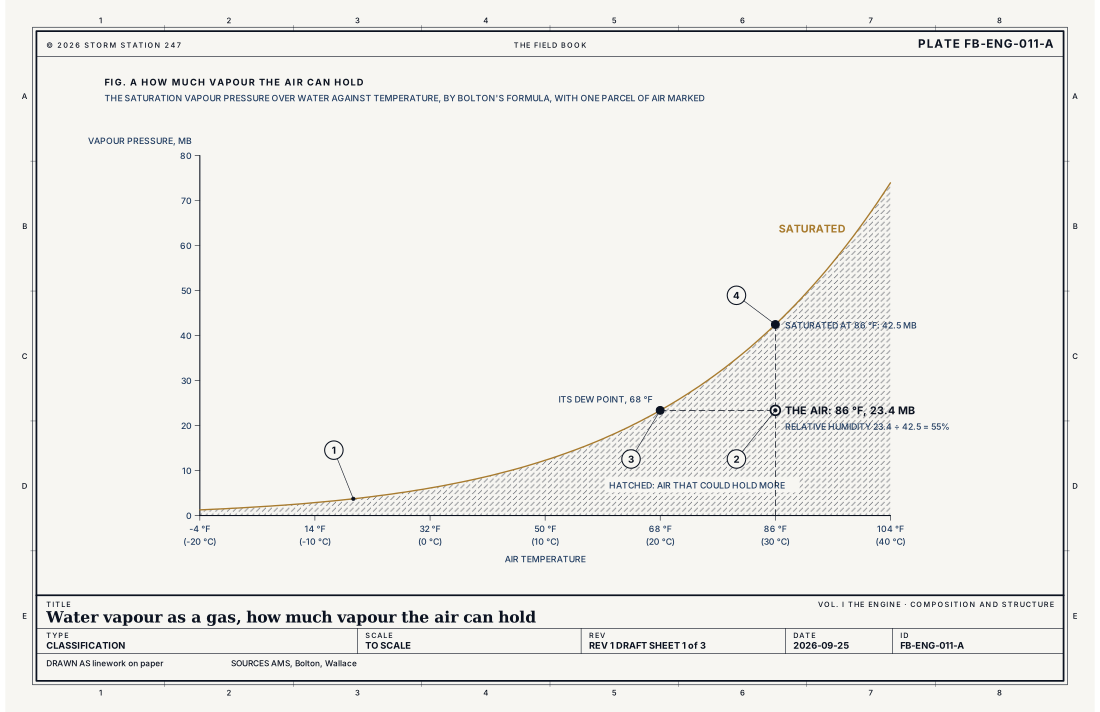
Each gas in the air presses on its own, and the vapour's share of the pressure is its vapour pressure. How much vapour the air can hold before it starts to condense depends only on the temperature. Fig. A draws it: saturated air at 32 °F (0 °C) holds 6.1 mb of vapour, at 68 °F (20 °C) 23.4 mb, and at 86 °F (30 °C) 42.5 mb. The amount nearly doubles for each 20 °F (11 °C) of warming, about 3.5 per cent for each degree Fahrenheit near 68 °F. That steep curve is the first equation below, and it sits under most of the weather.
What it is not
It is not steam or cloud. The white plume from a kettle and the cloud overhead are liquid drops, already condensed; the vapour itself cannot be seen.
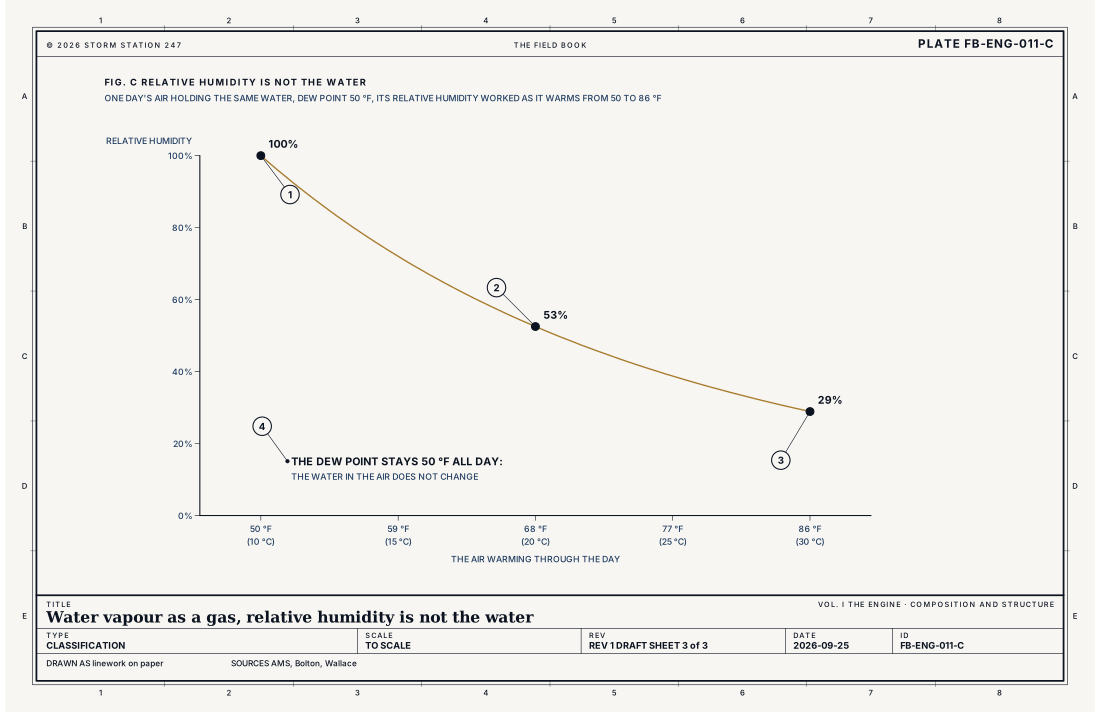
It is not the relative humidity. Relative humidity is a ratio: the vapour the air holds against what it could hold at its temperature. Fig. C follows one day's air with its water unchanged and its dew point at 50 °F (10 °C). It reads 100 per cent at dawn at 50 °F, 53 per cent at 68 °F and 29 per cent at 86 °F in the afternoon, holding exactly the same water all day.
Lookalikes
- Steam and clouds
- What is seen is liquid drops condensed from the vapour; the vapour itself is invisible.
- Relative humidity
- A ratio, not an amount: the same air reads 100 per cent at dawn and 29 per cent in the afternoon while holding the same water.
- Heavy, humid air
- Humid air feels heavy but weighs less than dry air at the same temperature and pressure.
The machine
Saturation
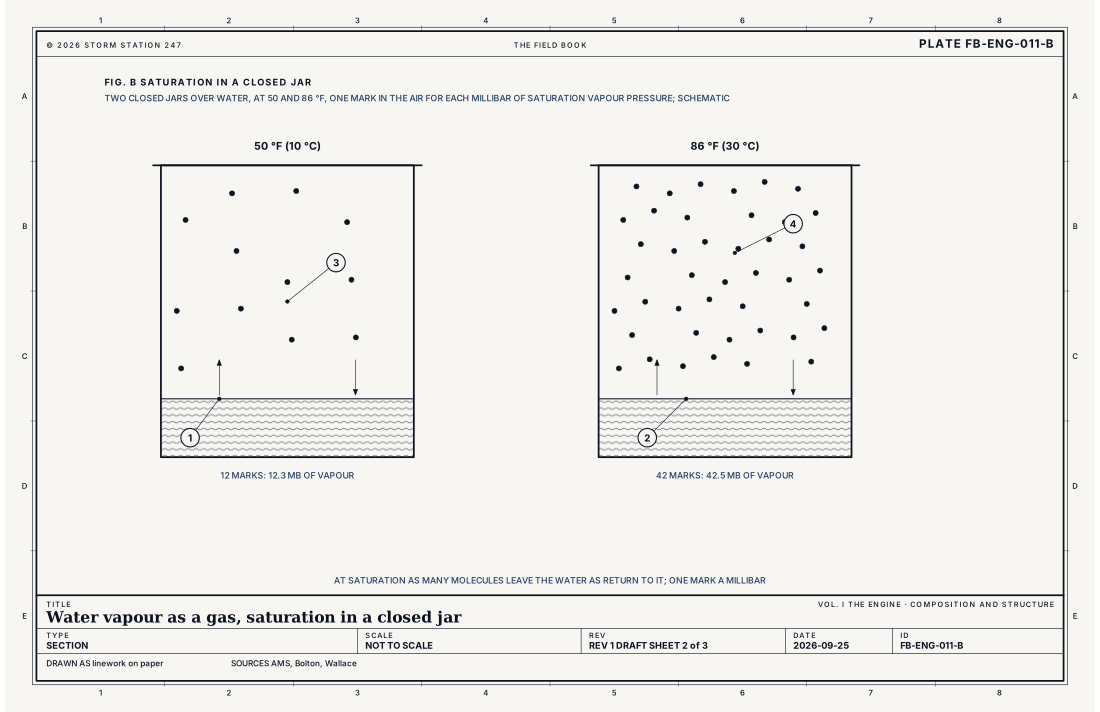
Over any water surface some molecules escape into the air and some return. Fig. B shows two closed jars. The air in each has come to saturation: as many molecules leave the water as return to it. The warmer jar holds more than three times the vapour of the cooler, 42.5 mb against 12.3 mb.
The dew point
The dew point is the temperature to which air must cool, keeping its water, to be saturated. It measures the water the air holds, and it stays steady through a day while the relative humidity swings, which is why forecasters watch it. The second equation below relates the two. Air at 86 °F with a dew point of 68 °F (20 °C) holds 23.4 mb of vapour against 42.5 mb possible: 55 per cent. When air cools to its dew point, dew, fog or cloud forms, Dew, frost and rime FB-WAT-021, Fog types FB-WAT-020.
Humid air is light
A water molecule weighs 18 units against about 29 for dry air, so humid air is lighter than dry air at the same temperature and pressure. That same 86 °F air holds vapour weighing about 1.5 per cent of the air, and it weighs what dry air 4.9 °F warmer would. The lightness helps humid air rise, Lapse rates and stability FB-ENG-005.
- The water, at 50 °F
- The water, at 86 °F
- The vapour at 50 °F, 12 mb
- The vapour at 86 °F, 42 mb
- Saturated at dawn, 50 °F
- 53 per cent at 68 °F
- 29 per cent at 86 °F
- The dew point, unchanged
Ingredients
- Water, from the oceans, lakes, soil and plants, evaporating into the air
- Temperature, which sets how much vapour the air can hold before it condenses
- Pressure, which the vapour shares with the rest of the air, each gas pressing on its own
Scales
- time
- evaporation and condensation adjust in seconds; the vapour in a place changes over hours and days as air masses come and go
- horizontal
- from a single cloud to an air mass a thousand miles (1,600 km) across
- vertical
- most of it within 10,000 ft (3 km) of the surface, where the air is warmest
- orlanski
- synoptic
Equations
The saturation vapour pressure
- the vapour pressure at which air is saturated over flat water, mb
- the temperature, °C
Assumes Bolton's fit to the Clausius Clapeyron equation, good to 0.1 per cent from −22 to 95 °F (−30 to 35 °C); over water, including supercooled water below freezing.
Working form Saturated air presses 6.1 mb of vapour at 32 °F, 12.3 mb at 50 °F, 23.4 mb at 68 °F and 42.5 mb at 86 °F: nearly double for each 20 °F (11 °C), about 3.5 per cent for each degree Fahrenheit (6.3 per cent a degree Celsius) near 68 °F.
Relative humidity and the dew point
- the relative humidity, per cent
- the dew point, the temperature to which the air must cool, at the same pressure and water, to be saturated
- the air temperature
Assumes The vapour pressure of the air equals the saturation pressure at its dew point, by the dew point's definition.
Working form Air at 86 °F with a dew point of 68 °F holds 23.4 mb of vapour against the 42.5 mb it could hold: 55 per cent relative humidity. That vapour is about 1.5 per cent of the air's weight, and it makes the air as light as dry air 4.9 °F warmer.
Signatures
- sounding
- the dew point line beside the temperature line; close where the air is moist and far apart where it is dry
- surface
- the dew point; steady through a day while the relative humidity swings; muggy nights above a dew point of about 65 °F (18 °C)
- satellite
- the water vapour channel; showing the moisture in the middle and upper troposphere
- radar
The numbers
| Quantity | Value, and the kind of number it is |
|---|---|
| Water vapour | Water in the gas state, invisible; clouds, fog and steam are liquid drops, not vapourStandard, Glossary of Meteorology |
| Dew point | The temperature to which air must be cooled, at constant pressure and water content, for saturationStandard, Glossary of Meteorology |
| Relative humidity | The ratio of the air's vapour pressure to the saturation vapour pressure at its temperature, in per centStandard, Glossary of Meteorology |
| Saturation vapour pressure | 6.1 mb at 32 °F (0 °C), 12.3 mb at 50 °F (10 °C), 23.4 mb at 68 °F (20 °C), 42.5 mb at 86 °F (30 °C), over waterTextbook, Bolton 1980 |
| Molecular weight | Water vapour 18, dry air about 29: humid air is lighter than dry air at the same temperature and pressureStandard, Glossary of Meteorology |
How the station sees it
An airport station measures the temperature and the dew point every minute and works the relative humidity from them. Road stations measure the dew point over the pavement, and a road that cools below it is a road about to frost.
- Airport weather stations: the temperature and the dew point every minute, from which the relative humidity is worked
- Road weather stations: the air and dew point over the pavement, the first warning of frost on a bridge
How it is warned
Water vapour is not warned. It feeds the heat index, Heat wave and heat dome FB-EVT-130, and every rain and snow forecast; a dew point climbing into the 60s °F (16 to 21 °C) is often the first sign of a stormy afternoon.
See also
- Composition of air FB-ENG-002
- Lapse rates and stability FB-ENG-005
- Radiation budget FB-ENG-007
- Fog types FB-WAT-020
- Dew, frost and rime FB-WAT-021
- The hydrologic cycle FB-WAT-030
- Heat wave and heat dome FB-EVT-130
Sources
- American Meteorological Society. Glossary of Meteorology.
- Bolton, D.. The Computation of Equivalent Potential Temperature, Monthly Weather Review 108 (1980).
- Wallace, J. M. and P. V. Hobbs. Atmospheric Science, An Introductory Survey, 2nd ed. (2006).
Definition after the Glossary of Meteorology. Plate FB-ENG-011, revision 1, 2026-09-25. The number is permanent; cite it.