What it is
The Earth turns, and everything on it turns with it: the ground, the buildings, the observer. Air that moves over the ground for a long time travels in a nearly straight line through space while the ground turns beneath it. Seen from the ground, its path curves: to the right in the Northern Hemisphere, to the left in the Southern. That curve is the Coriolis effect.
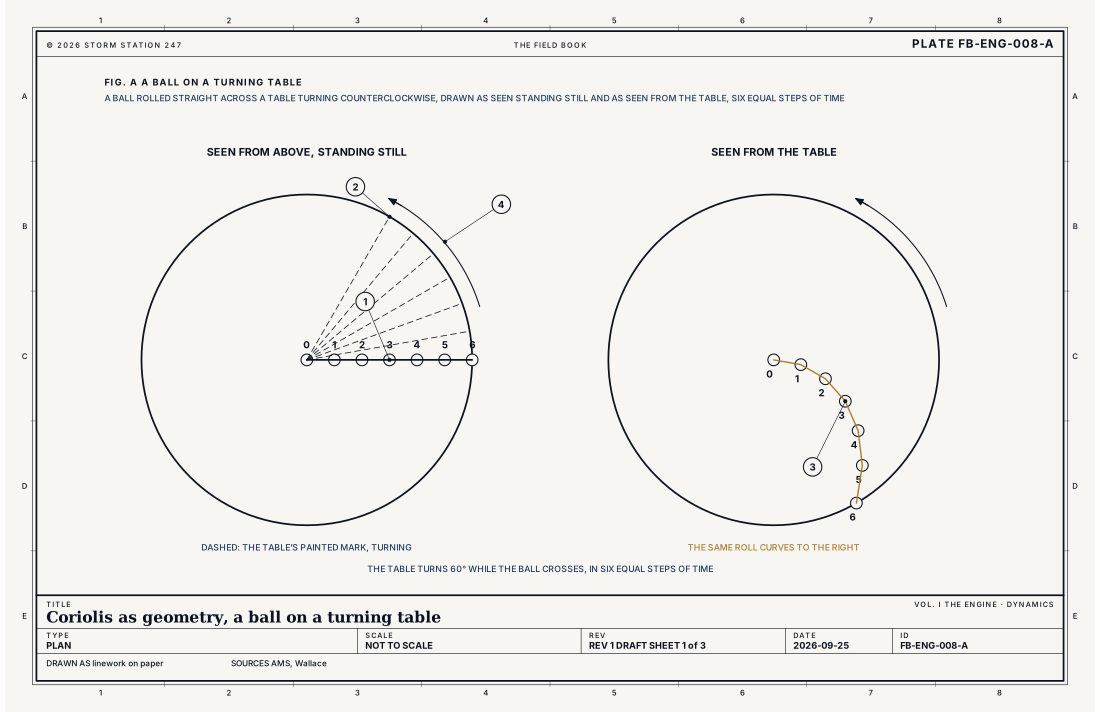
Fig. A shows it on a turning table. A ball rolled straight across a table turning counterclockwise runs straight as seen by someone standing beside it. Seen from the table, the same roll curves to the right, because the table has turned beneath the ball while it crossed. Nothing pushed the ball sideways. The curve is geometry: a straight path drawn on a turning floor.
What it is not
It is not a real push. No force acts on the air sideways; the deflection comes entirely from watching from a turning Earth. The weather equations still carry it as a force, because the weather is measured from the ground.
It is not why a sink drains one way or the other. Its effect on anything small and quick is far too weak, as the second equation below shows.
Lookalikes
- The swirl of a draining sink
- Its Rossby number is in the thousands: the basin's shape and the way it was filled decide the swirl, not the Earth.
- A tornado's spin
- Most turn counterclockwise because the storm that makes them does, and the storm's turn comes from the wind shear; a few turn clockwise.
- A real force
- Nothing pushes the air sideways; the ground turns beneath a straight path, so the path curves as seen from the ground.
The machine
How much of the spin counts
The Earth turns once against the stars every 23 hours 56 minutes. How much of that turn a place feels depends on its latitude. Fig. B splits the spin at 40° N into two parts: a turn about the local vertical and a turn about the local horizontal. Only the turn about the vertical swings horizontal motion sideways. At the poles all of the spin is about the vertical; at the equator none of it is, and the Coriolis effect on horizontal winds vanishes there. That is why hurricanes do not form within a few degrees of the equator, Hurricane FB-EVT-043.
The first equation below measures it with the Coriolis parameter, f: twice the spin times the sine of the latitude. At 40° N, f is 9.37 × 10⁻⁵ per second.
The inertial circle
Set air moving at 20 mph (8.9 m/s) at 40° N and let nothing act on it but the Earth's turn. It curves steadily right and runs round a circle 59 mi (95 km) in radius, back where it started after 18.6 hours. Fig. C draws the circle to scale. The period is half a pendulum day: 18.6 hours at 40°, 12.0 hours at the pole, and endless at the equator. Winds on real days carry the same swing, and it shows as a nighttime wind maximum over the Plains, the low level jet.
When it matters
The second equation, the Rossby number, compares a motion's own turning with the Earth's. At 40° N a winter low, 20 mph (8.9 m/s) across 600 mi (970 km), has a Rossby number of 0.1: the Earth's turn rules it. The wind cannot blow straight from high pressure into low; it is swung sideways until it blows round the low instead, counterclockwise in the Northern Hemisphere, Geostrophic and thermal wind FB-ENG-009. A supercell's mesocyclone is near 44, a tornado near 1,200 and a draining sink near 3,600: for each of those the Earth's turn is too slow to matter, Tornado FB-EVT-009.
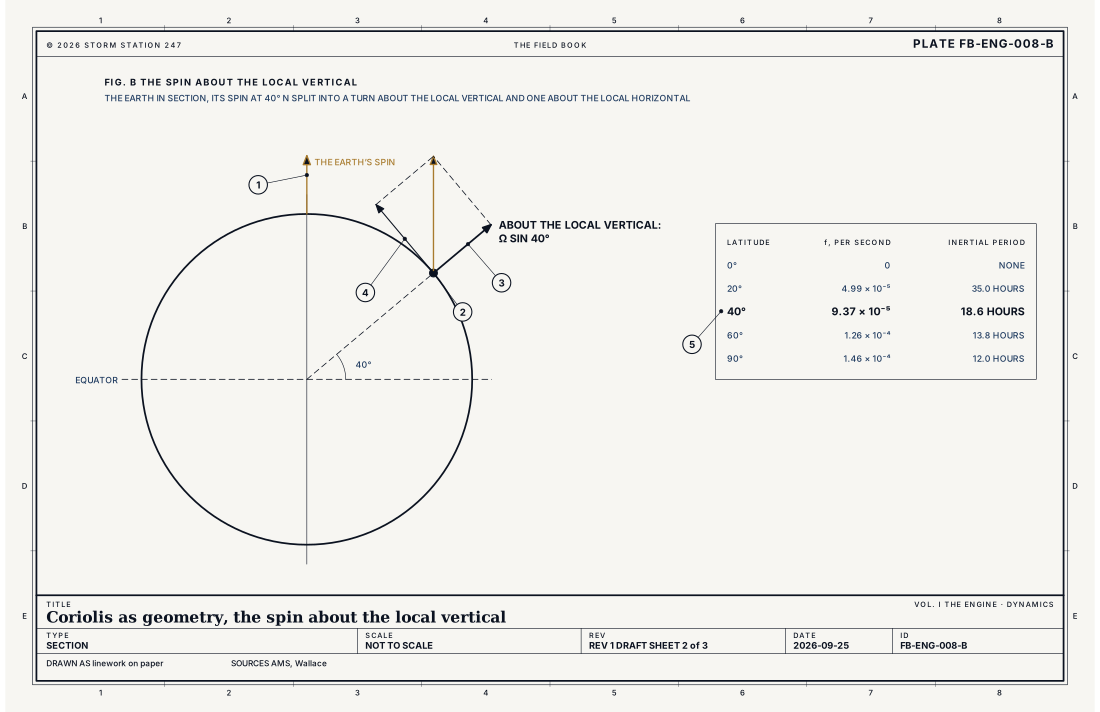
- The Earth's spin
- A place at 40° N
- The turn about the local vertical, Ω sin 40°
- The turn about the local horizontal
- The Coriolis parameter and inertial period by latitude
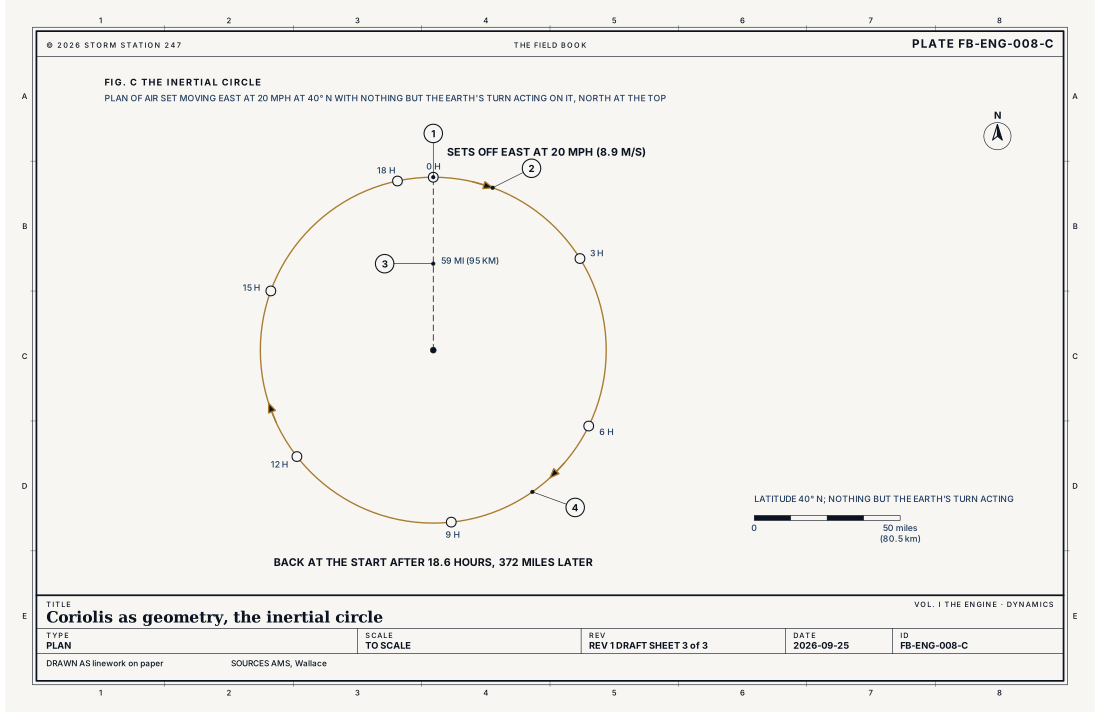
- Where it sets off, moving east
- It curves to the right
- The radius, 59 mi (95 km)
- Every 3 hours round the circle
Ingredients
- The Earth's spin, one turn against the stars every 23 hours 56 minutes
- Latitude, which sets how much of that spin is a turn about the local vertical: all at the poles, none at the equator
- Motion over the ground lasting long enough, and travelling far enough, for the turn beneath it to matter
Scales
- time
- it matters for motions lasting hours or longer; the air's inertial circle at 40° N takes 18.6 hours
- horizontal
- it matters for motions hundreds of miles (hundreds of km) across; it is negligible in a tornado or a sink
- vertical
- the whole atmosphere; it acts on horizontal motion at every height
- orlanski
- synoptic
Equations
The Coriolis parameter
- the Coriolis parameter, per second
- the Earth's rate of spin against the stars, 7.29 × 10⁻⁵ per second
- the latitude
- the sideways acceleration of air moving at speed V, at right angles to its motion
- the speed of the air over the ground
Assumes The horizontal part only; the Earth's spin about the local horizontal, the Ω cos φ part, bends vertical motion very slightly and is left out, as the weather equations leave it out.
Working form At 40° N, f is 9.37 × 10⁻⁵ per second. Air set moving at 20 mph (8.9 m/s) with nothing else acting runs round a circle 59 mi (95 km) in radius, clockwise, and is back where it started 18.6 hours later.
The Rossby number
- the ratio of a motion's own turning to the Earth's turn beneath it
- the motion's speed, m s⁻¹
- its size, m
- the Coriolis parameter, per second
Assumes A scale comparison, good to a factor of a few. Where Ro is much larger than 1 the Earth's turn does not matter; near 1 or smaller, it rules.
Working form At 40° N a draining sink, water moving 4 in (0.1 m) a second across 1 ft (0.3 m), has Ro near 3,600; a tornado, 100 mph (45 m/s) across a quarter mile (400 m), near 1,200; a supercell's mesocyclone, 45 mph (20 m/s) across 3 mi (4.8 km), near 44; a winter low, 20 mph (8.9 m/s) across 600 mi (970 km), 0.1.
Signatures
- sounding
- surface
- the wind blowing round lows and highs rather than straight into them; counterclockwise round lows and clockwise round highs in the Northern Hemisphere
- satellite
- the comma of a low and the spiral of a hurricane; turning counterclockwise in the Northern Hemisphere and clockwise in the Southern
- radar
The numbers
| Quantity | Value, and the kind of number it is |
|---|---|
| Coriolis effect | The apparent deflection of a moving object seen from a rotating frame; on the Earth, to the right of the motion in the Northern Hemisphere and to the left in the SouthernStandard, Glossary of Meteorology |
| The Earth's spin | 7.2921 × 10⁻⁵ radians a second, one turn against the stars in 23 hours 56 minutesStandard, Glossary of Meteorology |
| The inertial period | Half a pendulum day, 12 hours ÷ sin φ very nearly: 35.0 hours at 20°, 18.6 hours at 40°, 13.8 hours at 60°, 12.0 hours at the pole; none at the equatorThis site, Glossary of Meteorology |
| A Foucault pendulum | Turns once in 23.93 hours ÷ sin φ: 37.2 hours at 40°Standard, Glossary of Meteorology |
| Rossby number | The ratio of the inertial force to the Coriolis force in a flow; small for motions the Earth's turn controlsStandard, Glossary of Meteorology |
How the station sees it
An airport station records the wind's direction every minute. Near the ground, friction slows the wind and the Coriolis effect weakens with it, so the wind blows partly across the isobars, inward toward the low. A few thousand feet up, with less friction, it blows nearly along them. Stations across a whole map show the pattern: counterclockwise round each low and clockwise round each high, the hand of the Earth's turn on every weather chart, Midlatitude cyclone life cycle FB-EVT-060.
- Airport weather stations: the wind's direction and speed, which blow across the isobars near the ground and along them higher up
How it is warned
The Coriolis effect is not warned. It sets the direction every large storm turns and the track it takes. Every forecast of where a low or a hurricane will go carries it.
See also
- Hydrostatic balance FB-ENG-003
- Geostrophic and thermal wind FB-ENG-009
- Vorticity and stretching FB-ENG-010
- Tornado FB-EVT-009
- Hurricane FB-EVT-043
- Midlatitude cyclone life cycle FB-EVT-060
- Day and night FB-CLK-004
Sources
- American Meteorological Society. Glossary of Meteorology.
- Wallace, J. M. and P. V. Hobbs. Atmospheric Science, An Introductory Survey, 2nd ed. (2006).
Definition after the Glossary of Meteorology. Plate FB-ENG-008, revision 1, 2026-09-25. The number is permanent; cite it.